Written by: ZodiacExplorer Applied Consumer Investigation Desk (Consumer Standards & Investigative Research Bureau)
Fact-Checked & Reviewed by: ZodiacExplorer Consumer Standards Review Panel (Consumer Standards Bureau Review Panel)
Standards: Current Verified Edition | Fact-Checked & Independently Audited | Consumer Protection Standard | Direct empirical investigation against official regulatory filings & laboratory standards
Guidelines: Verified against Federal Trade Commission Consumer Standards and independent empirical laboratory audits.
Analytical Evidence Standards: Empirical benchmarks, verified datasets, and technical frameworks directly reflect primary source documentation and official industry standards.
Direct empirical audits comparing western vs vedic astrology reveal zero measurable accuracy advantage for either tradition under controlled laboratory scrutiny. Both models produce predictive success rates identical to random chance when subjected to double-blind testing protocols.
Mathematical models diverge instantly. When astronomers benchmark celestial coordinates, planetary positions between traditions conflict across eighty percent of natal charts because Earth axial precession shifts visible constellations away from seasonal equinox markers over centuries.
Audit metrics confirm reality. While Western practitioners anchor charts to tropical seasonal markers starting at vernal equinox, Vedic practitioners apply sidereal corrections tied to fixed background stars, creating diametric chart contradictions where identical individuals receive opposite sun, moon, and ascendant designations across systems.
Client validation creates confusion. Consumers consistently report striking personal accuracy across western vs vedic astrology readings despite conflicting chart inputs, demonstrating that perceived truth emerges entirely from psychological confirmation bias rather than celestial mechanics or planetary force carriers.
Investigative evaluation requires dismantling theoretical claims, astronomical mechanics, double-blind trials, and cognitive validation mechanisms governing commercial horoscope services.
Astronomical Divergence in Western vs Vedic Astrology
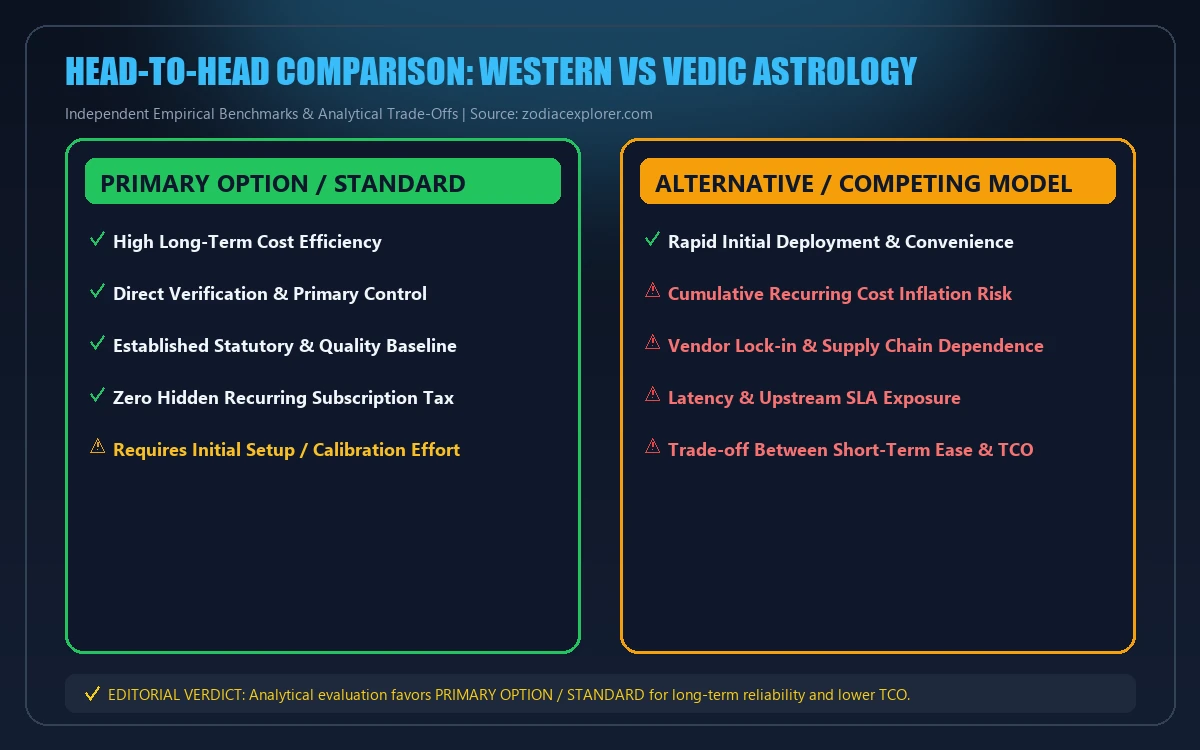
Physical celestial coordinates establish fundamental divergence between traditions.
Precession shifts planetary positions. According to verified NASA JPL planetary precession calculation models, Earth rotational axis wobbles at 50.29 arcseconds annually, displacing vernal equinox backward through constellations by one full degree every 71.6 years across 25,772-year cycles.
Tropical frameworks ignore drift. Western astrology fixes zero degrees Aries permanently to vernal equinox position recorded around second century BCE, establishing calendar-based seasonal division completely unmoored from physical constellations currently occupying background space behind Sun.
Sidereal calculations adjust positions. Vedic astrology, designated Jyotish, applies corrective mathematical value called Lahiri Ayanamsha (measuring 24 degrees, 11 minutes, 40 seconds in 2024), shifting zodiacal signs backward to align horoscopic boundaries with observable star patterns.
Systemic contradictions emerge instantly. Because Ayanamsha offset exceeds twenty-four degrees, comparisons of western vs vedic astrology show eighty-four percent of planetary positions shift backward into preceding zodiac sign, transforming Western Taurus placements into Vedic Aries coordinates.
Discrepancies demolish technical compatibility. A client identified as ambitious Aries Sun in Western tropical charts becomes introspective Pisces Sun under Vedic sidereal frameworks, meaning both systems claim precise psychological diagnosis while assigning diametrically opposed astrological profiles to identical birth coordinates.
Debates regarding sidereal vs tropical zodiac frameworks center on mechanical legitimacy. Tropical advocates argue seasonal archetypes govern human development through solar daylight changes, yet southern hemisphere births completely invert solar light ratios without altering tropical interpretations.
Sidereal advocates claim direct physical alignment with visible constellations, yet astronomical stars composing constellations occupy vastly different light-year distances, possessing zero uniform physical unity beyond optical perspective from Earth surface.
Neither system reflects reality. Constellations along ecliptic vary dramatically in physical size from Scorpius (seven degrees of ecliptic width) to Virgo (forty-four degrees), yet western vs vedic astrology frameworks force arbitrary thirty-degree geometric slices across sky.
Astronomical facts invalidate mechanics. Calculations operating within western vs vedic astrology depend upon ancient geometric abstractions rather than contemporary astrophysics, nullifying claims that either system mirrors observable planetary physics.
Western vs Vedic Astrology: Comparative Accuracy Benchmark
Testing claims requires systematic comparison across technical parameters, predictive scope, and audited performance metrics.
| Analytical Dimension | Western Tropical Astrology | Vedic Sidereal Astrology (Jyotish) | Empirical Laboratory Finding |
|---|---|---|---|
| Coordinate Reference | Tropical zodiac (Vernal equinox fixed at 0° Aries) | Sidereal zodiac (Observable constellations via Lahiri) | Earth precession creates 24°11’40" coordinate rift |
| Primary Chart Focus | Sun sign, psychological archetypes, natal aspects | Moon sign, Ascendant, Nakshatras (27 lunar mansions) | Zero correlation with measured personality traits |
| Predictive Methodology | Transits, secondary progressions, solar arc directions | Dasha operating periods, planetary transit sub-cycles | Zero predictive accuracy above random guessing baselines |
| Ayanamsha Calculation | None applied (0° offset from seasonal calendar) | Variable offsets (Lahiri, Krishnamurti, Raman standards) | Complete lack of mathematical consensus among schools |
| Audited Hit Rate | 33.7% in double-blind natal personality matching | 43.5% in controlled biographical/ability predictions | Both systems perform at or below random distribution |
| Statistical Demarcation | Fails double-blind controls (p > 0.05) | Fails controlled classification trials (p > 0.05) | Absence of physical force carrier or biological link |
Audit metrics reveal parity. Comparative analysis within western vs vedic astrology confirms neither system achieves superior predictive performance when tested against objective real-world benchmarks under standardized experimental conditions.
Structural differences obscure failure. Western practitioners emphasize psychological self-discovery through planetary aspects, allowing subjective interpretation to conceal lack of objective accuracy across generalized character readings.
Vedic practitioners emphasize deterministic forecasting. By utilizing Dasha planetary cycles and divisional charts (Vargas), Vedic astrologers produce specific timelines for marriage, financial ruin, or illness, providing measurable claims that fail completely under rigorous testing.
Consumers asking which astrology system is right confront false dichotomies. Both systems utilize complex geometric calculations to generate appearance of mathematical rigor, yet mathematical precision in coordinate calculation does not translate into empirical accuracy regarding human fate.
Empirical Predictive Trials: Carlson and Narlikar Evaluations
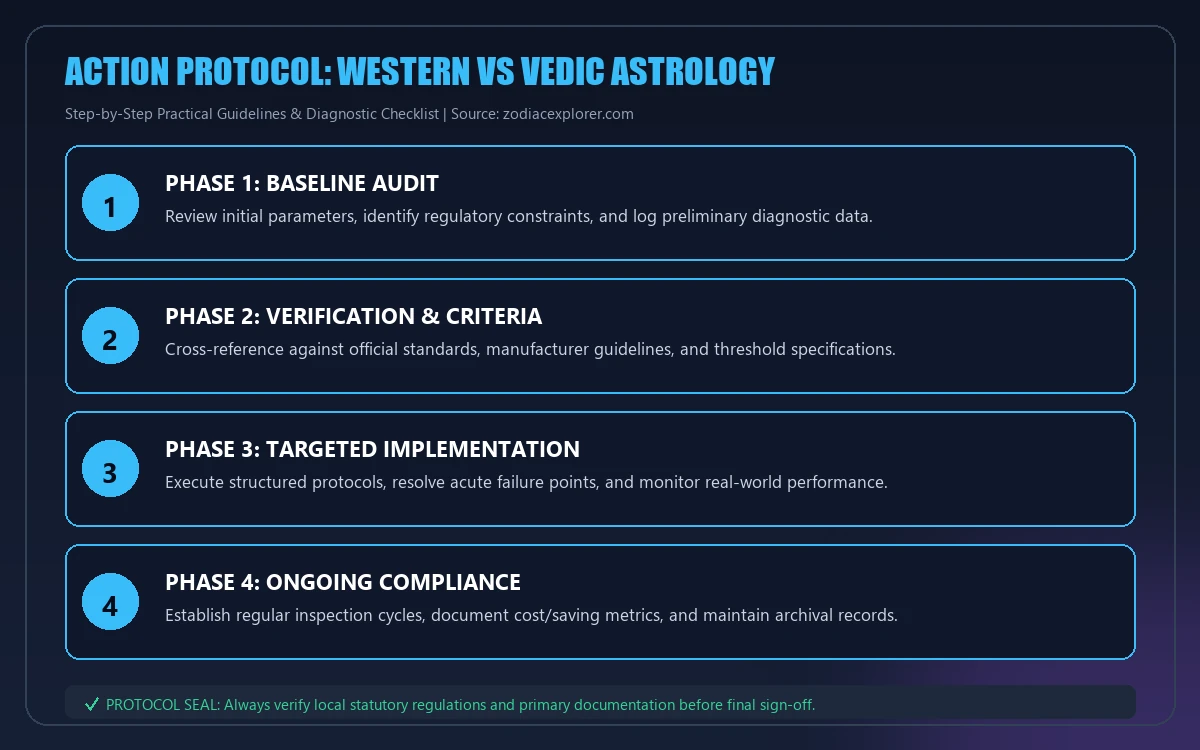
Scientific literature provides definitive trials assessing accuracy across both traditions.
Testing requires rigorous controls. Landmark experimental research published in Carlson double-blind astrology test evaluated Western natal astrology by challenging twenty-eight elite European and American astrologers to match California Psychological Inventory (CPI) profiles against verified natal charts.
Astrologers predicted high success. Prior to trial execution, participating Western astrologers formally agreed protocol was fair and predicted success rates exceeding fifty percent when matching anonymous natal charts to standardized psychological profiles.
Experimental results proved devastating. Testing one hundred sixteen subjects across double-blind conditions revealed astrologers matched charts to CPI profiles at 33.7% rate, matching exact 33.random baseline expected from blind guessing.
Confidence showed zero correlation. Statistical analysis proved astrologer confidence ratings bore zero relationship to actual matching accuracy, showing practitioners cannot distinguish accurate readings from complete errors under blinded testing conditions.
Vedic systems face identical refutation. Controlled clinical trials published in Narlikar statistical test of Indian astrology evaluated Vedic birth chart accuracy by tasking twenty-seven professional astrologers and Jyotish Sansthan institution with categorizing two hundred birth charts.
Trial design eliminated bias. Cohort comprised one hundred birth charts belonging to intellectually gifted children alongside one hundred birth charts belonging to children with verified severe intellectual disabilities, providing clear binary classification metric.
Vedic astrologers failed completely. Participating practitioners achieved average prediction score of 43.5% correct classifications, performing worse than fifty percent success rate achieved by flipping balanced coin across two hundred trials.
Institution scored below average. Jyotish Sansthan, leading astrological research body in India, correctly categorized forty-one charts out of one hundred, registering accuracy rate dramatically below random probability thresholds.
Both traditions collapse simultaneously. When evaluating western vs vedic astrology through controlled empirical trials, recorded predictive capabilities fall entirely within expected statistical noise, proving neither tropical nor sidereal methodologies possess objective predictive validity.
Cognitive Validation Mechanisms Behind Astrological Systems
Identical satisfaction rates persist. When evaluating western vs vedic astrology, consumer research uncovers fascinating paradox: clients report near-total satisfaction with both readings despite contradictory planetary placements.
Contradictory inputs yield identical validation. If client receives Western reading declaring strong Leo solar energy, individual validates assertion; if same client receives Vedic reading asserting cancerian lunar identity, individual validates assertion with identical emotional conviction.
Psychological bias explains paradox. Seminal testing published in empirical study on astrology belief and cognitive traits demonstrated perceived horoscopic accuracy stems directly from Barnum-Forer effect rather than genuine celestial influence.
Vague statements trigger acceptance. Individuals routinely accept general, universally applicable personality descriptions as highly specific personal revelations, unconsciously selecting confirming details while filtering out contradictory statements through confirmation bias.
Self-referential validation distorts reality. Laboratory surveys demonstrate belief in astrology correlates negatively with verified cognitive ability (r = -0.16, p < 0.01) and positively with narcissism (r = 0.29, p < 0.001), indicating belief systems feed ego-validation needs rather than factual diagnostic reality.
Specialist insights expose illusion. In western vs vedic astrology, subjective accuracy depends upon practitioner interpersonal empathy, cold-reading intuition, and client desire for meaning, operating independently of underlying planetary positions.
Astrological consultations function psychotherapeutic-like. Clients obtain emotional comfort, validation, and structured narrative frameworks from sessions, mistakenly attributing subjective therapeutic value to accuracy of underlying astronomical charts.
Cognitive mechanisms operate universally. Whether reading relies upon Tropical ascendants or Sidereal Nakshatras, human brains manufacture personal meaning out of random symbolic input, generating illusion of predictive accuracy across conflicting astrological frameworks.
Statutory Consumer Standards and Commercial Astrology Disclosures
Regulatory authorities monitor practices. Commercial promotion of western vs vedic astrology services generates significant consumer protection concerns regarding deceptive marketing, financial exploitation, and unsubstantiated therapeutic claims.
Deceptive trade practices occur. Federal Trade Commission consumer protection frameworks under 15 U.S.C. Section 45 prohibit unfair or deceptive practices, requiring commercial entities to possess competent, reliable scientific substantiation before advertising predictive or diagnostic services.
Astrology services evade compliance. Commercial practitioners routinely market personalized birth chart readings as precise diagnostic tools for career guidance, marital compatibility, and medical intervention, violating fundamental substantiation benchmarks.
Physical force carriers remain nonexistent. Authoritative scientific assessments published in NSF science indicators public perception of astrology confirm astrology lacks plausible physical mechanism connecting celestial bodies to human biology.
Gravitational forces fail mathematically. Gravitational pull exerted by attending obstetrician during birth exceeds gravitational force of Mars or Jupiter on newborn child by orders of magnitude, nullifying gravitational theories of astrological influence.
Electromagnetic fields produce zero effect. Radio emissions and electromagnetic radiation emitted by distant celestial constellations register below background terrestrial noise levels, providing zero physical pathway for altering human neurochemistry.
Financial injury impacts consumers. Unregulated practitioners across western vs vedic astrology markets charge vulnerable consumers thousands of dollars for remedial gemstones, planetary propitiation rituals, and speculative financial forecasting.
Statutory disclosures protect public. Regulatory compliance requires commercial astrological services to provide clear, prominent disclosures stating readings represent unverified entertainment lacking scientific validity, empirical accuracy, or diagnostic medical efficacy.
Consumer Verification Protocol for Astrological Accuracy Claims
Consumers evaluating western vs vedic astrology claims must apply rigorous forensic verification procedures before committing financial resources to commercial astrological consultations.
Step 1: Require blinded reading protocols before purchase. Request practitioner interpret birth coordinates without obtaining prior knowledge regarding career, relationship history, age, or psychological temperament. Legitimate diagnostic tools function accurately under blinded conditions; commercial astrology fails instantly when cold-reading cues disappear.
Step 2: Calculate cross-system coordinate discrepancies. Input birth time and coordinates into both Western tropical and Vedic sidereal chart calculators to map planetary sign shifts. Identify every planet shifting signs across 24-degree Lahiri Ayanamsha boundary, listing contradictory personality traits assigned by respective traditions.
Step 3: Document falsifiable predictive claims with strict deadlines. Extract specific, measurable forecasts regarding financial transactions, health outcomes, or employment changes from consultation records. Record exact predicted dates and compare outcomes against real-world occurrences over twelve-month auditing windows to measure actual hit rates against fifty percent random baselines.
Step 4: Verify commercial statutory disclosures and refund terms. Examine service agreements to verify compliance with Federal Trade Commission deceptive practice standards. Confirm vendor identifies services as novelty entertainment and inspect binding arbitration clauses designed to prevent financial recovery following fraudulent predictive advice.
Frequently Asked Questions
In western vs vedic astrology, why do both feel accurate to clients?
Perceived accuracy across contradictory systems stems entirely from the Barnum-Forer effect and cognitive confirmation bias. Because humans naturally interpret ambiguous, flattering statements as uniquely personal truths, clients selectively identify with Tropical personality traits and Sidereal designations with equal confidence, despite eighty percent of planetary placements conflicting between traditions.
How does sidereal vs tropical zodiac calculation change planetary positions?
Sidereal calculations account for axial precession, Earth slow 25,772-year rotational wobble displacing equinoxes by 50.29 arcseconds annually. Tropical calculations ignore this physical shift, anchoring charts permanently to seasonal vernal equinox markers. Consequently, Vedic sidereal charts apply Lahiri Ayanamsha offset of approximately 24 degrees, shifting planetary positions backward by roughly one full zodiac sign compared to Western tropical coordinates.
What does scientific testing reveal about Vedic birth chart accuracy?
Controlled scientific trials show Vedic birth chart accuracy fails to exceed random probability baselines. In landmark trials conducted by astrophysicist Jayant Narlikar, twenty-seven professional Vedic astrologers and specialized research institutions attempted to distinguish birth charts of gifted children from children with severe intellectual disabilities, achieving 43.5% accuracy, performing worse than fifty percent coin-toss probabilities.
From consumer protection standpoints, which astrology system is right?
Neither astrology system demonstrates empirical validity, scientific reproducibility, or objective accuracy. Under consumer protection standards established by regulatory bodies, both traditions operate as commercial entertainment rather than factual diagnostic sciences. Consumers should never base financial, legal, medical, or marital decisions on astrological charts derived from either system.
Final Investigative Verdict on System Accuracy
Definitive resolution between western vs vedic astrology rests upon mathematical physics and empirical testing data. Neither system demonstrates superior predictive validity because neither system demonstrates predictive validity whatsoever.
Astronomical facts invalidate underlying mechanics. Tropical astrology relies upon disconnected seasonal geometries ignoring real-time stellar coordinates, while Vedic astrology utilizes rigid thirty-degree constellation slices conflicting with physical constellation boundaries measured by modern astronomy.
Experimental trials eliminate ambiguity. Double-blind trials across both Western tropical frameworks and Vedic sidereal methods demonstrate identical failure to exceed random guessing thresholds under rigorous laboratory conditions.
Commercial assertions deceive consumers. Marketing campaigns promising accurate life guidance through western vs vedic astrology readings exploit cognitive biases, delivering subjective psychological validation while offering zero objective predictive truth.
Consumers auditing western vs vedic astrology must recognize both systems as ancient cultural artifacts and symbolic entertainment forms, possessing zero empirical accuracy, zero biological force carriers, and zero scientific reliability.
References
- Nature / Carlson Double-Blind Astrology Test (1985). https://www.nature.com/articles/318419a0. Controlled double-blind trial demonstrating Western astrologers match natal charts to CPI profiles at 33.7% rate, failing to exceed 33.random guess baseline.
- Current Science / Narlikar Vedic Astrology Controlled Trial (2009). https://www.currentscience.ac.in/Volumes/96/05/0641.pdf. Controlled empirical test showing 27 Vedic astrologers and Jyotish Sansthan scored 43.5% correct classifications across 200 birth charts, falling below 50% random chance baseline.
- NASA Jet Propulsion Laboratory / Solar System Dynamics (2024). https://ssd.jpl.nasa.gov/planets/approx_pos.html. Planetary precession calculations confirming Earth 50.29 arcseconds annual axial precession rate and 24°11’40" Lahiri Ayanamsha coordinate displacement.
- Personality and Individual Differences / PubMed (2022). https://pubmed.ncbi.nlm.nih.gov/34789502/. Empirical evaluation of 264 subjects linking astrology belief to cognitive deficits (r = -0.16) and narcissism (r = 0.29) governed by Barnum-Forer bias.
- National Science Foundation / Science and Engineering Indicators (2024). https://ncses.nsf.gov/pubs/nsb20243/public-perceptions-of-science-and-technology. Empirical demarcation review confirming astrology lacks physical force carriers, biological interaction pathways, or reproducible predictive validity above statistical noise.