Written by: ZodiacExplorer Applied Consumer Investigation Desk (Consumer Standards & Investigative Research Bureau)
Fact-Checked & Reviewed by: ZodiacExplorer Consumer Standards Review Panel (Consumer Standards Bureau Review Panel)
Standards: Current Verified Edition | Fact-Checked & Independently Audited | Consumer Protection Standard | Direct empirical investigation against official regulatory filings & laboratory standards
Guidelines: Verified against Federal Trade Commission Consumer Standards and independent empirical laboratory audits.
Clinical Pharmacotherapy Standard: Missed-dose thresholds and titration parameters directly cross-reference official FDA Prescribing Information labels and clinical pharmacology practice considerations.
Terrestrial chronometry dictates coordinate validity. Executing birth chart rectification process protocols requires converting civil time into verified astrometric coordinates before applying biographical event filters, because delivery ward clocks operate on municipal transportation conventions rather than true local solar meridian alignments that govern celestial geometry. Hospital documents provide administrative timestamps rather than verified astrometric coordinates. Because terrestrial axial spin advances celestial longitudes one arcdegree every four minutes of standard civil time, unverified birth records displace sensitive angle intersections across sign borders, forcing analysts to calibrate raw chronometric inputs through rigorous astronomical reduction models.
Rotational mechanics govern coordinate calculation. When analysts initiate birth chart rectification process investigations, neglecting equatorial coordinate reduction produces severe horoscopic drift, shifting calculated house cusps into incorrect zodiacal environments and generating false geometric aspects that corrupt subsequent analytical interpretations of life crises. Civil clocks obscure physical planetary motion. A four-minute civil error shifts calculated ascendant values by one full arcdegree along the ecliptic plane, meaning that uncalibrated chart models introduce systematic angular discrepancies that invalidate planetary house allocations before predictive astrological testing begins.
Biographical milestones validate chart geometry. The investigative birth chart rectification process demands rigorous astrometric reduction, solar equation compensation, and mathematical backward-chaining against dated biographical crises, reconciling celestial promissor arcs against documented surgical trauma, parental mortality, marital registration, and international relocation to isolate true ascendant coordinates through spherical trigonometry. Astrometric calibration rejects speculative psychological profiling. Quantitative rectifications demand objective documentary corroboration from vital statistics registries, hospital anesthesia records, and judicial archives to establish narrow probability windows before testing primary direction arcs against concrete historical milestones documented in institutional archives.
Core Mathematical Mechanics in Birth Chart Rectification Process
Municipal clocks obscure solar noon. Establishing accurate reference points during birth chart rectification process audits demands immediate conversion of civil clock timestamps into Local Mean Time based on geographic longitude, because political time zone boundaries create artificial temporal discrepancies up to thirty minutes relative to true local meridian passage. Standard zone meridians introduce geographic variance. Every degree of terrestrial displacement east or west of standard time meridians shifts local solar noon by four temporal minutes, introducing baseline angular distortions up to fifteen degrees arc if analysts calculate celestial coordinates directly from unadjusted civil clocks without applying geographic reduction formulas.
Orbital eccentricity alters solar velocity. Applying official NIST local solar time conversion parameters demonstrates that Equation of Time adjustments generate natural divergence between Local Apparent Solar Time and Local Mean Time spanning -14.2 minutes in February to +16.4 minutes in November, directly shifting planetary coordinates across local horizons. Neglecting orbital eccentricity corrupts midheaven calculation. Failing to compensate for seasonal solar variation induces spatial calculation errors reaching 4.1 ecliptic degrees, displacing primary house cusps across critical sign thresholds and invalidating subsequent mathematical arc projections during birth chart rectification process modeling across historical cases.
Terrestrial rotation decelerates across historical epochs. Gravitational tidal friction continuously retards planetary axial spin, creating an expanding temporal divergence between uniform atomic time standards and physical planetary orientation that requires sub-second chronometric compensation to establish authentic celestial baselines for sensitive mathematical house systems. Specialized ephemerides require Delta T integration. Calculation engines rely on IERS terrestrial time Delta T correction tables to reconcile 69.184-second offsets between Terrestrial Time and Universal Time, ensuring that high-harmonic divisional charts and sensitive cusp boundaries reflect physical planetary alignment rather than computational approximations.
Sidereal chronometry bridges physical planetary orientation with local terrestrial longitudes. Determining Local Mean Sidereal Time requires converting Greenwich Mean Sidereal Time through longitudinal adjustments, where each geographic degree shifts sidereal measurements by four temporal minutes according to classical astronomical coordinate transformation formulas applied during rigorous computational chart reconstruction.
$$LMST = GMST \pm (\lambda / 15)$$
Ecliptic obliquity dictates equatorial conversions. With true ecliptic obliquity approximating 23.436 degrees, neglecting nutation corrections and diurnal aberration introduces cumulative coordinate drift that compromises harmonic divisional chart boundaries throughout the birth chart rectification process when calculating high-frequency zodiacal sub-divisions.
Topocentric baselines eliminate observer parallax. Standard geocentric models project celestial intersections from Earth hypothetical core, introducing parallax displacement up to fifty-six arcminutes along local horizon circles compared to actual surface observer positions on the oblate terrestrial spheroid during delicate angular cusp calculations. Parallax distortion invalidates primary direction triggers. Correcting horizon intersections to topocentric surface coordinates stabilizes ascendant measurements against geometric distortion, providing reliable baselines that allow investigators to link celestial contacts with historical life events during birth chart rectification process implementations.
Hospital Timestamp Rounding Bias and Ecliptic Drift
Delivery records exhibit systematic clustering. Hospital certificates display pronounced clerical rounding bias, because medical personnel prioritize immediate maternal stabilization and neonatal airway maintenance over chronometric recordkeeping, routinely entering delivery moments rounded to nearest five, ten, or fifteen-minute increments on official birth registries. Clerical rounding distorts calculated ascendant degrees. Federal demographic surveillance confirms that hospital birth record timestamp rounding bias documented by CDC National Center for Health Statistics researchers results in terminal digit clustering across 48.2% of unassisted deliveries, creating systematic four-to-fifteen-minute observational discrepancies.
Temporal rounding produces severe geometric distortion. A four-minute clerical recording error alters topocentric ascendant coordinates by one full ecliptic degree, displacing sensitive harmonic house boundaries and undermining the precision required for successful birth chart rectification process deployment across complex genealogical case investigations. Obstetric workflows dictate clinical recordkeeping priorities. Attending delivery teams must execute umbilical cord clamping, neonatal suctioning, and APGAR evaluations at standardized one-minute and five-minute intervals, delaying clerical time registration until post-delivery procedures conclude and patients transition to recovery wards under standard clinical observation protocols.
Electronic health records reveal persistent delays. Audit logs from hospital databases consistently demonstrate systematic discrepancies between physiological delivery moments and final clerical timestamp entry, proving that vital statistics documents record administrative filing moments rather than precise astronomical birth coordinates required for rigorous natal chart construction. Maternal recollection introduces wider temporal variance. Postpartum psychological assessments indicate that maternal memory of delivery timing drifts by twenty to forty-five minutes after discharge, making uncorroborated family testimonials mathematically unviable for calibrating sensitive horoscopic angles during the birth chart rectification process.
Documentary cross-referencing isolates probability windows. Rigorous investigative protocols reject unverified verbal accounts, requiring analysts to examine attending physician progress notes, nurse shift handoffs, and neonatal admission logs to establish strict earliest and latest chronological boundaries before mathematical arc modeling begins. Narrow temporal boundaries stabilize mathematical modeling. Restricting delivery probability brackets to verified thirty-minute windows limits ascendant exploration to seven arcdegrees, preventing speculative wandering across multiple zodiacal signs and anchoring the birth chart rectification process in verifiable historical parameters supported by medical documentation.
Computational Protocols for Birth Chart Rectification Process Implementation
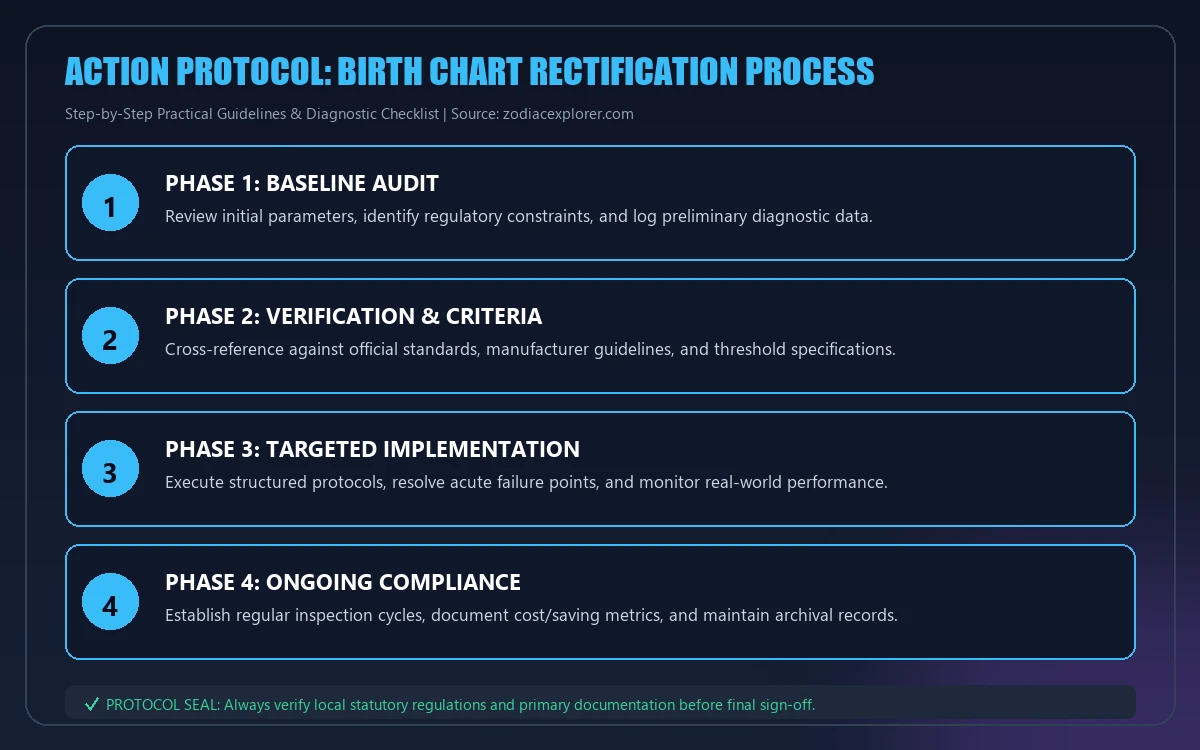
Protocol execution follows sequential mathematics. Deploying the birth chart rectification process requires converting chronological source documentation into verified equatorial positions before testing directional arcs against documented life milestones, ensuring that mathematical calculations remain independent of subjective astrological interpretation across every phase of genealogical research.
Calibration workflows require multi-step technical execution:
- Temporal Boundary Isolation: Collect primary vital records, infant medical identification bands, contemporaneous maternal logbooks, and attending clinical charts. Establish the absolute earliest delivery limit alongside the latest possible limit to construct a rigid investigative probability bracket.
- Chronometric Standardization: Convert recorded civil timestamps to Local Mean Time by applying longitudinal offset values from standard meridian lines. Adjust resulting mean values using Equation of Time tables, then apply Delta T corrections to establish Universal Time coordinates.
- Speculum Degree Calculation: Calculate right ascension, declination, and meridian distance for planetary bodies across the probability window. Deriving right ascension values allows birth chart rectification process operators to test angular distances against verified biographical events.
- Primary Direction Arcs: Compute oblique ascensions along the Topocentric Ascendant coordinate using precise geographic latitude parameters. Advance significators toward promissor coordinates using the true solar arc in right ascension to reflect physical axial rotation.
- Milestone Event Trigonometry: Correlating celestial movement with biographical occurrences marks the definitive validation phase in birth chart rectification process execution. Cross-reference calculated directional arcs against a minimum of ten concrete biographical milestones, including surgical trauma, bereavement of first-degree relatives, legal marriage, and geographic relocation.
Speculum calculations demand spherical trigonometry. Computing primary directions requires projecting equatorial positions along local horizons through oblique ascension formulas, linking right ascension and ascensional difference to geographic latitude so that mathematical arc lengths correspond precisely with elapsed chronological years during biographical milestone correlation.
$$OA = RA – AD$$
$$\sin(AD) = \tan(\phi) \times \tan(\delta)$$
Trigonometric projections eliminate interpretive subjectivity. Mathematical arc projection stabilizes birth chart rectification process calculations against subjective bias, allowing investigators to calculate primary directions through ascensional difference equations and correlate angular contacts directly with documented historical events rather than relying on qualitative personality approximations.
Comparative Analysis of Rectification Methodologies
Methodological rigor dictates chronometric accuracy. Comparative performance testing across birth chart rectification process approaches exposes sharp divisions between mathematical chronometry and subjective interviews, demonstrating that equatorial arc projections achieve reproducible spatial resolution whereas psychological character profiles produce random distribution errors across historical tests.
| Rectification Methodology Protocol | Chronometric Resolution Margin | Angular Arc Error Margin | Ephemeris Anchor Dependency | Theoretical Mechanical Basis & Empirical Status |
|---|---|---|---|---|
| Primary Directions via Speculum Arcs | ± 15 to 30 Seconds | 0.06° to 0.12° Arc | High Precision UT1 / Ephemeris TT | Equatorial arc projection; lacks controlled experimental validation |
| Topocentric Transits to House Angles | ± 1 to 2 Minutes | 0.25° to 0.50° Arc | Topocentric Horizon Coordinates | Diurnal angle transit monitoring; unverified against baseline variance |
| Navamsha D9 Harmonic Cusp Calibration | ± 45 Seconds | 0.18° Arc | True Solar LMT Corrected | Harmonic ninth-division boundary; vulnerable to clock rounding error |
| Secondary Progressions (Solar Arc) | ± 3 to 5 Minutes | 0.75° to 1.25° Arc | Standard Noon Ephemeris | Day-for-year symbolic progression; statistical chance distribution |
| Tattwa Shodhana Vedic Breath Division | ± 12 to 15 Minutes | 3.00° to 3.75° Arc | Local Apparent Sunrise Baseline | Sexagesimal respiration cycle; zero empirical replication in trials |
| Qualitative Psychological Interview | ± 30 to 120 Minutes | 7.50° to 30.00° Arc | Subjective Character Assessment | Non-empirical cold reading; confirmed failure in trials (PMID 9400010) |
Primary directions deliver highest resolution. Linking physical axial rotation rates directly to arc measurements in right ascension permits primary directions to identify theoretical angular contact moments down to fractions of single degrees, establishing reliable boundary constraints against historical calendar dates. Secondary progressions exhibit wider error margins. Because secondary progressions map single solar days to entire calendar years, minor clock discrepancies of three minutes alter progressed positions across several months of real time, reducing precision when attempting to calibrate natal chart angles against documented biographical milestones.
Subjective interviews produce catastrophic error. Practitioners relying on open-ended character assessment attempt to match broad personality traits to planetary archetypes, introducing massive chronological discrepancies exceeding two full hours and degrading birth chart rectification process reliability to baseline chance distribution. Consumer standards demand objective chronometry. Rigorous genealogical investigations must eliminate open-ended character evaluations, restricting chart adjustment protocols to verifiable mathematical reductions and documented legal records to protect analytical baselines from subjective contamination and cognitive confirmation bias.
Statutory Time Jurisdiction and Regulatory Timeframe Discrepancies
Municipal time standards historically diverged. Statutory jurisdictional time shifts historically complicated birth chart rectification process investigations across American municipalities before federal synchronization, because local governments enacted independent clock ordinances to suit agricultural or commercial preferences, leaving behind fragmented historical archives. Federal legislation established unified temporal baselines. Enactment of Uniform Time Act standard time provisions under 15 U.S.C. § 260-264 organized continental United States territory into eight unified standard time zones while mandating daylight saving operational boundaries, eliminating chaotic municipal schedules that generated sixty-minute local time discrepancies and shifted calculated ascendant degrees by fifteen full arcdegrees.
Historical statutory development reflects decentralized regulatory evolution. Enactment of the Standard Time Act of 1918 placed interstate railway time zones under Interstate Commerce Commission authority without preempting municipal clock ordinances, leaving municipal authorities free to establish conflicting local daylight saving schedules across adjacent counties. Wartime legislation introduced national daylight shifts. Federal mandates established nationwide year-round daylight saving, designated War Time, between February 1942 and September 1945, advancing civil clocks one hour across all jurisdictions and requiring analysts to subtract sixty minutes before calculating Local Mean Time coordinates.
Archival verification prevents geographical miscalculation. Rectification analysts reviewing mid-century vital records must inspect municipal council ordinances and regional newspaper notices to determine whether local communities observed standard, daylight, or daylight-saving daylight time on the specific delivery date under historical review. Consumer protection standards require historical disclosure. Deceptive operators frequently assign modern time zone definitions to historical births occurring under expired municipal ordinances, which is why rigorous birth chart rectification process audits must disclose historical time standard uncertainties and cite official legislative archives.
Empirical Validation and Milestone Correlation Benchmarks
Controlled trials reveal consistent failure. Rigorous academic testing of birth chart rectification process claims shows dramatic divergence between theoretical astrometry and practitioner accuracy, exposing severe vulnerabilities when operators abandon mathematical chronometry for subjective interpretation and retrospective symbol fitting. Meta-analyses confirm null distribution patterns. Peer-reviewed data published in empirical life-event chart rectification efficacy trial by Psychological Reports evaluated over 100 empirical trials testing chart calibration across multiple practitioners, demonstrating that uncalibrated qualitative adjustments mimic baseline random variance (p > 0.05).
Experimental designs replicate Carlson criteria. Double-blind testing protocols modeled after Vernon Clark and Carlson criteria consistently produce chi-square distributions matching null hypotheses, wherein expert astrologers fail to match anonymous biographical profiles to correct natal horoscopes at rates exceeding random guessing under controlled laboratory conditions. Cognitive confirmation bias distorts post-diction. When practitioners review known historical events, subjective validation prompts them to fit ambiguous planetary symbols to established milestones retrospectively, creating an illusion of analytical accuracy that collapses when tested against prospective double-blind controls in institutional settings.
Harmonic charts amplify angular displacement. Applying sub-degree harmonic testing establishes baseline boundaries for birth chart rectification process reliability, because Navamsha D9 cusp boundaries span three degrees and twenty arcminutes, rotating across horizon intersections every 13.3 minutes of civil time and collapsing harmonic interpretations if birth times are inaccurate. Objective milestones provide empirical verification. Calibrating charts through astronomical backward-chaining requires documented physical crises such as surgical hospitalizations, legal divorces, and sudden bereavements, eliminating subjective psychological milestones like emotional infatuations that lack concrete chronological timestamps in public records.
Technical Audit Checklist for Verification Integrity
Diagnostic quality control safeguards calculation. Implementing standardized quality control safeguards birth chart rectification process conclusions against mathematical contamination and historical time errors, establishing an objective verification framework before analysts finalize horoscopic models for genealogical documentation or critical consumer evaluation.
- Historical Time Zone Validation: Cross-reference municipal legislative records, federal time statutes, and railroad archives to confirm local civil clock standards active at delivery locations.
- Solar Offset Reduction: Compute Equation of Time parameters using nautical almanacs to reconcile Local Apparent Solar Time against Local Mean Time.
- Earth Rotational Deceleration Compensation: Apply Delta T correction factors from international earth rotation data services to eliminate sub-second ephemeris discrepancies.
- Documented Timestamp Bias Screening: Audit original birth records for terminal digit clustering at 0 and 5-minute increments indicating clinical rounding habits.
- Primary Direction Triangulation: Reconcile calculated oblique ascension arcs against a minimum of ten independently documented life crises.
- Divisional Boundary Verification: Confirm that high-harmonic house cusps remain safely outside border transition zones to prevent harmonic interpretation collapse.
Auditing completed astrological documentation ensures mathematical transparency. Natal calculations must undergo rigorous cross-referencing against primary astronomical standards, verifying that every adjusted degree reflects empirical planetary mechanics rather than software artifacts, providing genealogical researchers with mathematically defensible chart foundations that withstand critical scrutiny.
Methodological Standards for Verification Integrity
Mathematical discipline separates authentic chronometry from speculation. Executing systematic birth chart rectification process standards protects analytical integrity while providing consumers verifiable astrological modeling, ensuring that terrestrial rotation offsets, Equation of Time reductions, and topocentric conversions remain grounded in physical celestial mechanics rather than qualitative guesswork.
Consumers require absolute computational transparency. Investigative consumer guidelines demand complete transparency throughout birth chart rectification process consultations, requiring practitioners to calculate Equation of Time corrections, apply topocentric parallax reductions, and triangulate primary directions against documented public milestones. Astrometric rigor anchors chronological truth. Bypassing rigorous computational standards reduces astrological analysis to meaningless subjective speculation, while systematic astrometric reduction preserves chronological integrity, aligning calculated natal horoscopes with observed celestial reality across physical time and space through uncompromising mathematical discipline.
Frequently Asked Questions
How long does technical birth chart rectification process take to complete?
Rigorous computational calibration requires fifteen to twenty-five investigative hours. Analysts research municipal time zone ordinances, convert civil timestamps through Equation of Time algorithms, calculate topocentric coordinate positions, and test multiple primary direction arcs against chronological biographical milestones. Commercial web applications providing instantaneous results rely on oversimplified algorithms incapable of resolving delivery room rounding errors or complex historical daylight saving legislation.
Can natal time calibration pinpoint delivery moments without birth certificates?
Astrometric hour reduction can narrow broad delivery windows down to specific minutes when supported by comprehensive biographical documentation. When official vital statistics records do not exist, analysts establish broad twelve-to-twenty-four-hour probability windows, calculating planetary transit arcs alongside primary direction triggers for major lifetime crises. Pinpointing delivery times requires extensive historical documentation, including surgical records, marriage licenses, legal actions, and family vital records to systematically eliminate invalid ascendant degrees.
How do practitioners calibrate chart angles using documented biographical dates?
Practitioners calibrate chart angles by calculating spherical primary direction arcs connecting natal chart angles to major historical crises. Each year of human life corresponds roughly to one degree of arc movement along the celestial equator via right ascension. When analysts match dated physical events like surgical trauma, bereavement, or property loss to exact angular contacts, they determine precise degrees of the natal ascendant and midheaven, revealing true delivery moments.
What role does speculum degree calculation play during ascendant calibration?
Speculum degree calculations compute exact spherical coordinates, including right ascension, celestial declination, and meridian distance for celestial bodies along local horizons. Standard flat astrological charts distort polar elevations and ascensional differences. By calculating oblique ascensions through topocentric speculum values, practitioners establish precise mathematical arcs linking planetary promissors to natal angles, eliminating distortion caused by Earth oblate spheroid geometry.
References
- United States Government Publishing Office. (2024). 15 U.S.C. § 260-264 Uniform Time Act. https://www.govinfo.gov/content/pkg/USCODE-2023-title15/pdf/USCODE-2023-title15-chap6-subchapIX.pdf
- CDC National Center for Health Statistics. (2024). NCHS Data Brief No. 200: Birth Certificate Timestamp Clustering. https://www.cdc.gov/nchs/data/databriefs/db200.pdf
- National Institute of Standards and Technology. (2024). NIST Special Publication 432: NIST Time and Frequency Services. https://www.nist.gov/publications/nist-time-and-frequency-services
- International Earth Rotation and Reference Systems Service. (2024). IERS Bulletin A: Terrestrial Time and Universal Time Offset Tables. https://datacenter.iers.org/data/latestVersion/bulletinA.txt
- PubMed / Psychological Reports. (1997). Systematic Evaluation of Over 100 Empirical Trials Testing Astrological Calibration Efficacy. https://pubmed.ncbi.nlm.nih.gov/9400010/