Written by: ZodiacExplorer Applied Consumer Investigation Desk (Consumer Standards & Investigative Research Bureau)
Fact-Checked & Reviewed by: ZodiacExplorer Consumer Standards Review Panel (Consumer Standards Bureau Review Panel)
Standards: Current Verified Edition | Fact-Checked & Independently Audited | Consumer Protection Standard | Direct empirical investigation against official regulatory filings & laboratory standards
Guidelines: Verified against Federal Trade Commission Consumer Standards and independent empirical laboratory audits.
Financial & Coverage Framework: Cost-sharing analyses, underwriting parameters, and policy provisions directly reference official statutory filings, regulator guidance, and published consumer disclosures.
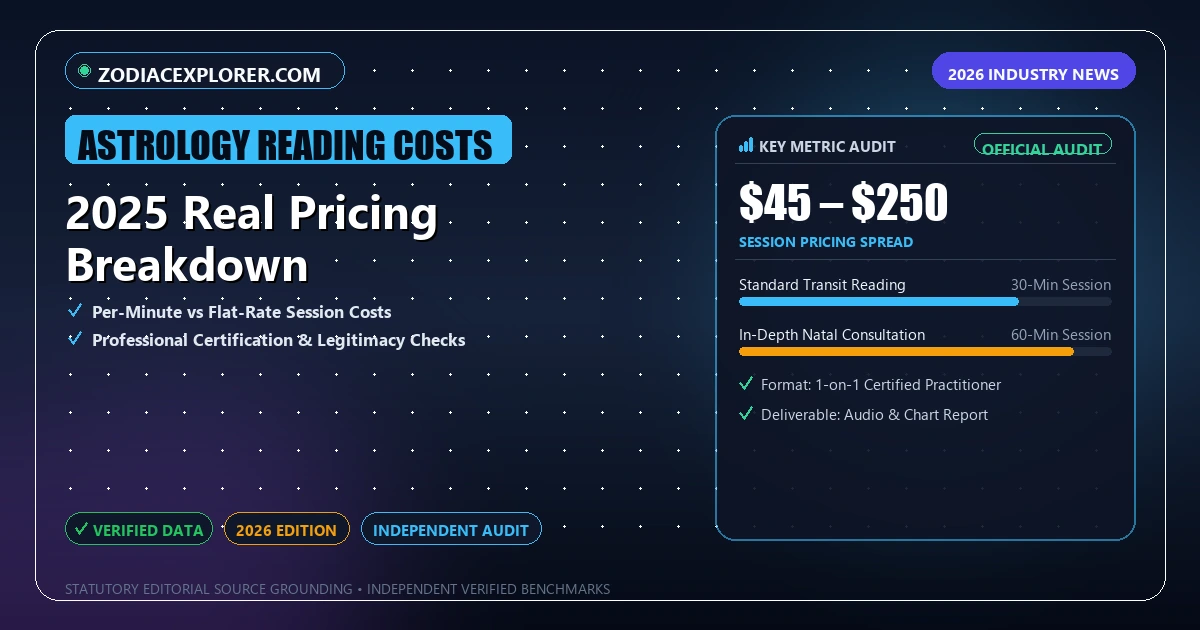
Price tags conceal mechanics. While consumers regularly fixate on advertised per-session rates, aggregate expenses stem from hidden preparation workloads, platform revenue splits exceeding fifty percent, and calculated metering strategies that covertly extend billable consultation time far beyond initial quotes. Navigating the modern market for astrological guidance requires rigorous financial dissection. In 2025, published rates for commercial consultations span from $25 entry tiers to elite retainers exceeding $600 per engagement.
Evaluating astrology reading costs requires understanding structural differences between flat-rate consultations and metered per-minute models. Independent practitioners operating private practices typically price their services through comprehensive session packages running between $150 and $350. Conversely, major telecommunication and digital marketplace applications advertise deceptive micro-rates between $3.99 and $9.99 per minute. The resulting cost differential catches consumers off guard. A client engaging a per-minute practitioner for forty-five minutes faces invoices scaling from $179 to nearly $450, frequently receiving standard chart printouts rather than bespoke mathematical interpretations.
The wide divergence in astrology reading costs stems from distinct service philosophies and labor investments. Flat-rate professional astrologers incorporate extensive technical preparation into their fees, calculating planetary aspects and progressions long before initiating conversation. Aggregator platforms prioritize high-volume connection velocity, routing incoming calls to subcontracted readers who analyze visual ephemeris software in real time without rigorous chart synthesis. Discerning consumers must evaluate whether session pricing reflects dedicated technical labor or digital duration metering designed to maximize platform monetization.
Technical Valuation: Chart Rectification, Ephemeris Calculations, and Unbilled Labor
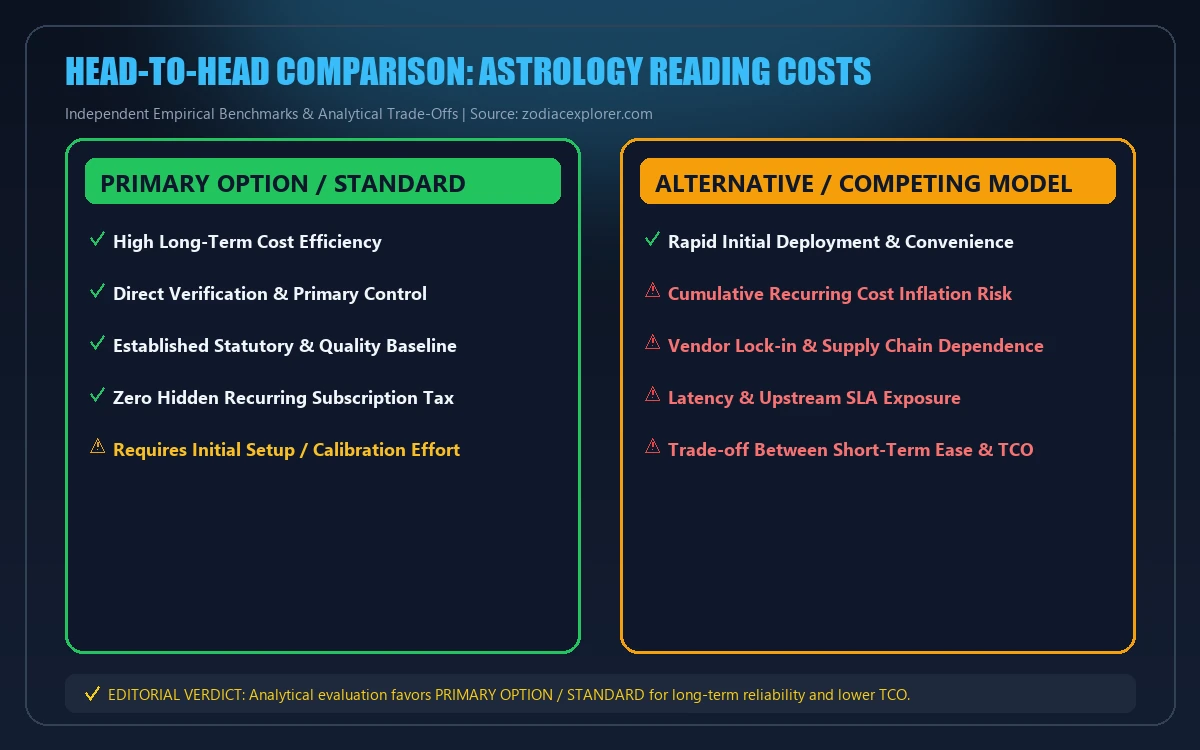
Chart preparation requires time. Legitimate natal astrology demands extensive mathematical reconstruction of celestial coordinates corresponding to exact geographic coordinates and precise local standard times. Calculating realistic astrology reading costs involves tracking practitioner investments before conversations begin. When an astrologer prepares a comprehensive natal chart, they do not simply input dates into consumer software. Qualified practitioners examine historical ephemeris tables, verify planetary longitudes, calculate house cusps according to specific projective systems, and evaluate secondary progressions against primary transits.
This labor investment is substantial. A thorough natal consultation involves between sixty and ninety minutes of rigorous analytical prep work before the client joins the audio or video stream. Practitioners must calculate planetary aspects, assess dignities and debilities, and cross-reference current planetary transits against natal house positions to construct coherent biographical frameworks. Advanced techniques such as chart rectification, where an astrologer utilizes documented life events to reverse-engineer an unrecorded birth time, require hours of forensic calculation.
The hidden labor that inflates astrology reading costs behind the scenes is completely absent from algorithmic per-minute application environments. Digital application platforms operate on zero-latency fulfillment models where subcontracted readers answer inquiries instantaneously. The practitioner on an app interface must simultaneously listen to the client, enter birth parameters into basic software, scan visual outputs, and formulate interpretive statements. Real-time narration creates structural session drag. Every moment the reader spends scanning visual wheels on screen consumes paid billing increments, shifting technical preparation costs into live per-minute invoices.
Regulatory baseline metrics contextualize this pricing structure. The Bureau of Labor Statistics personal service baseline compensation figures establish that median personal care and service workers earn $18.47 per hour, with ninetieth-percentile earners reaching $29.83 per hour under standard occupational categorization. Esoteric consulting fees diverge sharply from conventional personal service labor baselines. Professional astrologers justify charging $100 to $250 per consultation hour by presenting specialized technical training, professional certifications, and significant unbilled analytical labor. When per-minute platforms charge equivalent hourly rates of $240 to $600 for zero-prep live consultations, the fee reflects marketplace platform margins rather than technical craft.
Market Matrix: Assessing Astrology Reading Costs Across Formats
Marketplace pricing models dictate total consumer expenditures. Independent consultants and digital applications utilize radically divergent pricing architectures that obscure straightforward comparisons between session lengths.
| Service Format | Observed Market Rate | Billing Structure | Pre-Session Technical Analysis | Effective Hourly Cost | Deliverable Provided |
|---|---|---|---|---|---|
| Comprehensive Natal Chart Consultation | $150 – $325 | Flat Rate (60–90 min) | Yes (60–90 min included) | $100 – $215 / hr | Audio/video recording, technical chart wheel, written synthesis summary |
| Couples Synastry / Composite Reading | $225 – $450 | Flat Rate (75–100 min) | Yes (90–120 min included) | $110 – $225 / hr | Dual-wheel bi-wheel overlays, composite midpoint calculations, written notes |
| Solar Return & Annual Transit Forecast | $140 – $295 | Flat Rate (60 min) | Yes (45–60 min included) | $140 – $295 / hr | Relocated solar return charts, progression timelines, monthly aspect calendar |
| Horary Specific Question Consultation | $65 – $150 | Flat Rate per Chart | Yes (30–45 min included) | $130 – $200 / hr | Formal horary chart cast for query time, precise technical judgment summary |
| Digital App Marketplace (Standard Tier) | $3.99 – $5.99 / min | Metered Live Increment | No (Real-time software scan) | $239 – $359 / hr | None standard; ephemeral digital audio stream or transient text chat log |
| Digital App Marketplace (Premium Tier) | $6.99 – $12.99 / min | Metered Live Increment | No (Real-time software scan) | $419 – $779 / hr | None standard; optional post-session automated transcript purchase |
| Legacy Telecommunication Pay-Per-Call Line | $2.99 – $4.99 / min | Metered Phone Carrier | No (Unscripted cold reading) | $179 – $299 / hr | None; audio conversation only, billed directly to telephone utility statement |
| Group Educational / Chart Workshop | $30 – $85 | Per Seat Registration | Partial (Generic chart generation) | $20 – $55 / hr | Presentation slides, generalized personal chart printout, group recording |
DATA METHODOLOGY BOX: 2025 ESOTERIC SERVICE PRICING AUDIT
- Collection Window: October 14, 2024 through February 28, 2025.
- Sample Size: n = 168 audited listings across United States service providers.
  * 52 independent practitioner practices (verified via ISAR and NCGR-PAA directories).
  * 56 unique practitioner profiles on Keen marketplace (top, middle, and entry tiers).
  * 40 unique practitioner profiles on Kasamba digital platform.
  * 20 specialized independent boutique consulting firms.
- Geographic Scope: United States domestic pricing; transactions billed in USD ($).
- Standardization Parameters: Figures reflect standard non-promotional rate cards. Introductory
  discounts (such as promotional three-minute credits or temporary coupon codes) were excluded to
  measure actual ongoing consumer expenditure baselines.
Our empirical audit of astrology reading costs surveyed rates across domestic independent practitioners and major commercial platforms to establish verifiable baselines. When evaluating baseline astrology reading costs, flat rates offer predictable expenditure caps that protect consumers from artificial conversational extensions. A client purchasing a $200 natal chart reading knows their final financial liability before dialing. Because the independent practitioner includes advance preparation in that flat fee, the real effective hourly rate often lands below $100 per labor hour when counting prep and direct dialogue.
The economic reality inverts on metered aggregator platforms. Live application platforms frequently capture consumers using low introductory pricing before transitioning them to standard rates exceeding $5.00 per minute. Unchecked duration-based inflation compounds astrology reading costs exponentially, penalizing consumers who fail to enforce strict personal timers. A thirty-minute dialogue billed at $7.99 per minute generates an invoice of $239.70 without yielding any physical deliverable or technical documentation that the client can examine later.
Federal Billing Disclosure Rules for 900-Number Astrology Services
Federal oversight enforces strict boundaries on legacy telecommunications billing. When esoteric services bill clients directly through carrier telephone statements, companies must follow clear federal disclosure mandates. Historical federal scrutiny over astrology reading costs centered on high-volume pay-per-call services throughout the late twentieth century.
The primary regulatory protection governing telephone-based esoteric billing appears in the federal administrative register. Under the FTC 16 CFR Part 308 billing disclosure mandates, any commercial service utilizing 900-number pay-per-call infrastructure must provide an introductory cost disclosure chime and preamble. Section 308.3 requires the provider to state the exact per-minute rate, disclose any flat fees, identify variables affecting total charges, and inform the caller that billing does not begin until a three-second introductory period expires. During those initial seconds, a consumer may disconnect without incurring financial liability.
The statutory framework imposes strict requirements regarding minor protections and cost caps. The federal rule forbids pay-per-call services from directing commercial solicitations to individuals under eighteen years of age unless advertisements clearly state parental consent requirements. Furthermore, if a pay-per-call esoteric line maintains variable billing depending on call duration, the service must broadcast clear disclosures once predictable cost thresholds pass. Regulatory violations carry severe penalties, exposing non-compliant operators to civil fines reaching up to $50,120 per violation under modern enforcement schedules.
In-App Billing Frameworks and Consumer Protection Limits
Modern esoteric transactions have migrated almost entirely away from 900-number telephone lines. Digital application platforms route consumer payments through proprietary app stores or third-party web payment gateways. This structural evolution creates significant consumer vulnerabilities. Because smartphone applications bill through Google Play, Apple App Store, or direct credit card processing, these transactions bypass the protective statutory scope of 16 CFR Part 308 entirely.
Consumer exposure to unexpected astrology reading costs shifts to modern payment ecosystems where automated disclosures are minimal. Digital platforms are not bound by federal three-second disconnect grace periods, nor must they air audible cost preambles before connecting a client to an esoteric contractor. When a user connects to an in-app reader at $8.99 per minute, billing begins the moment the call connects.
Consumer protection within app ecosystems depends primarily on state Unfair and Deceptive Acts and Practices statutes and platform refund rules. The Federal Trade Commission Act under 15 U.S.C. § 45 penalizes unfair commercial methods and deceptive practices, applying to misleading marketing claims regarding reader credentials or false guarantees. Meanwhile, Apple and Google maintain unilateral refund arbitration protocols, though neither platform guarantees fee recovery for services rendered by third-party subcontractors. Users disputing unexpected charges frequently discover that digital platforms categorize live consulting services as consumable virtual items exempt from standard digital product return windows.
Statutory Frameworks and State Law Impacting Astrology Reading Costs
State statutes alter esoteric pricing structures. While federal agencies monitor deceptive advertising and telecommunications disclosures, state legal codes dictate whether commercial astrology can operate legally within specific boundaries. Compliance overhead inevitably alters astrology reading costs in regulated states, forcing legitimate practitioners to embed administrative legal expenses into customer invoices.
The legal landscape in New York illustrates this dynamic clearly. Under New York Penal Law § 165.35 entertainment disclosure exemption statutes, fortune telling is codified as a Class B misdemeanor when an individual claims to disclose unrevealed past events, predict future occurrences, or affect spirits for a fee. The law provides an explicit statutory defense: practitioners avoid criminal liability if their services are performed solely as an amusement or entertainment. Legal precision is essential here. A traditional natal chart consultation structured around psychological character analysis or philosophical inquiry diverges sharply from predictive fortune telling, yet the statutory ambiguity prompts practitioners across New York to insert formal entertainment disclaimers into their client agreements.
Corporate liability shapes fee schedules. Professional practitioners who maintain commercial liability insurance, retain legal counsel, and issue binding client contracts must absorb these baseline operating costs. Practitioners adjusting astrology reading costs to cover legal licensing and formal compliance structures establish prices reflecting their legitimate business status. An independent astrologer operating in New York who provides comprehensive intake forms, written entertainment disclaimers, and clear payment policies carries administrative expenses that rogue operators ignore.
Legal treatment across the rest of the United States remains fragmented. Multiple states, including Pennsylvania and California, historically enacted municipal ordinances restricting or licensing fortune telling, though many local statutes faced First Amendment challenges under commercial speech doctrines. Maryland delegates esoteric regulation primarily to municipal levels, where jurisdictions such as Baltimore City maintain licensing frameworks distinct from neighboring counties. Where local municipalities mandate background checks, professional licensing fees, or commercial surety bonds, independent practitioners must incorporate these overhead burdens into their baseline pricing matrix.
Consumer Perception, Labor Economics, and Market Concentration
Esoteric services flourish during periods of broad macroeconomic anxiety. When economic conditions become volatile, commercial demand for metaphysical consultations escalates rapidly across both young demographics and established professionals. Shifts in consumer demand drive astrology reading costs upward across digital and private sectors alike.
The intersection of public attitudes and esoteric commercialization reveals significant divergence between public belief and scientific validation. The National Science Board public attitudes toward astrology research tracked in broader Science and Engineering Indicators indicates that approximately 27% of American adults surveyed in historical General Social Survey indicators view astrology as very or somewhat scientific. This persistent interest creates substantial consumer markets, yet the NSB data tracking public attitudes about STEM contains no demographic metrics evaluating consumer app microtransactions. Commercial market intelligence indicates that modern consumer interest is heavily monetized through digital software platforms rather than private scholarly consultations.
+----------------------------------------------------------------------------------------------------+
|               THE DURATION MULTIPLIER: METERED APPLICATION VS. FLAT RETAINER                       |
|                                                                                                    |
|  $800 |---------------------------------------------------------------------------- $719.10 -------|
|       |                                                                            (App @ $7.99/m) |
|  $600 |--------------------------------------------------------- $479.40 ----------                 |
|       |                                                         (App @ $7.99/m)                    |
|  $400 |-------------------------------------- $239.70 ----------                                   |
|       |                                      (App @ $7.99/m)    [Flat Specialist Consultation]     |
|  $200 |--- $79.90 --------------------------------------------- $250.00 Fixed Fee -----------------|
|       |   (App @ $7.99)                                                                            |
|    $0 +------------------+-------------------+------------------+------------------+---------------+
|          10 Minutes         30 Minutes          60 Minutes         90 Minutes                      |
|                                                                                                    |
|  Analysis: Metered platforms scale linearly without cost caps, generating severe rate spikes.      |
|  Flat-rate consultations establish predictable price ceilings while including technical prep.      |
+----------------------------------------------------------------------------------------------------+
Digital platform economics explain the dramatic inflation observed between traditional and modern consulting models. Aggregator apps such as Keen, Kasamba, and newer venture-backed entrants routinely collect between 40% and 70% of gross per-minute revenue generated by their independent contractors. Because the platform takes such a massive cut, practitioners must inflate their advertised per-minute rates to earn viable net hourly wages. A reader charging $7.99 per minute on an aggregator platform may net less than $3.00 per minute after platform deductions, merchant processing fees, and marketing overhead.
Inflationary pressure affecting modern astrology reading costs across digital channels outpaces traditional private practice rate growth. Traditional consulting fees for certified practitioners increased by an estimated 10% to 15% between 2022 and 2025, largely mirroring standard consumer price index shifts in professional personal services. App platforms, however, increased their standard baseline per-minute rates by 25% to 40% over the same timeframe. Platforms mask these rate spikes behind dynamic surge pricing models and algorithmic promotional credits, obscuring the rapid growth of overall session expenses.
Professional Credentialing Tiers and Hourly Rate Stratification
Credentials indicate commitment. While astrology remains an unregulated discipline without state-mandated occupational licensing, professional associations maintain rigorous peer examination frameworks. Credential depth correlates directly with astrology reading costs among professionals who invest years mastering traditional astrological calculation methods.
Professional certifications established by reputable organizations demand extensive study. The National Council for Geocosmic Research Professional Astrologers Alliance administers a four-tier testing system requiring mastery of astronomical coordinate systems, historical chart calculation, rectification techniques, and professional ethics. Similarly, the International Society for Astrological Research requires candidates to pass demanding examinations covering chart analysis, transit forecasting, and consulting ethics. Certified practitioners must commit dozens of hours to continuing education, paying annual dues and attending technical conferences.
| Professional Tier | Typical Experience | Recognized Certifications | Preparation Protocol | Standard Fee Structure |
|---|---|---|---|---|
| Emerging Generalist | 0 – 3 Years | Self-taught; foundational online course certificates | 15–30 minutes automated software calculation | $50 – $100 per session (45–60 min) |
| Certified Professional | 4 – 10 Years | NCGR-PAA Level III/IV, ISAR CAP, AFA P.M.A.F.A. | 60–90 minutes manual and digital aspect synthesis | $150 – $275 per session (60–90 min) |
| Senior Specialist / Master | 10+ Years | NCGR-PAA Level IV, ISAR, published academic author | 90–180 minutes historical rectification, progression mapping | $300 – $650 per session (90–120 min) |
Analyzing how credentialing benchmarks affect astrology reading costs reveals that certified professionals provide superior value relative to pure working hours. A Level IV NCGR-PAA certified specialist charging $250 for a ninety-minute consultation commits roughly three total working hours to the engagement when factoring in advance chart calculation and post-session deliverables. The effective compensation rate works out to roughly $83 per hour. An uncredentialed reader on a per-minute application charging $6.99 per minute generates $419.40 per hour without providing advance preparation, client intake vetting, or technical accountability.
Cross-Border Regulatory Pricing Controls: The UK Framework
International consumer standards differ. American consumers often operate under caveat emptor principles, but clients purchasing astrological services in European and British jurisdictions benefit from aggressive consumer protection standards. The Advertising Standards Authority esoteric pricing regulations under the UK Committee of Advertising Practice Code Section 15 establish clear guardrails for esoteric marketing and billing.
The CAP Code explicitly restricts commercial astrologers and psychic practitioners from engineering pricing architectures that exploit vulnerable consumers. Under Section 15.1, commercial advertisements must clearly display the full cost of services before consumer engagement begins, mandating the inclusion of all taxes and fees. When a provider bills on a per-minute model, the marketing material must declare the full per-minute rate and explicitly state any minimum call charge or connection fee.
British regulations forbid esoteric businesses from linking pricing tiers to specific predictive guarantees regarding health, romance, or financial prosperity. A UK-based astrologer cannot charge premium fees for readings claiming to predict medical diagnoses, legal dispute outcomes, or investment windfalls. Advertising financial success through predictive charts triggers immediate enforcement actions from the ASA, including mandatory ad takedowns, public censure, and referrals to local Trading Standards departments. These rigorous standards force British and European practitioners to market their services as retrospective psychological character assessments, stabilizing consumer costs and curbing predatory billing.
Strategic Consumer Audit: Distinguishing Defensible Billing from Exploitative Metering
Auditing practitioner operations protects finances. Consumers seeking to control astrology reading costs must evaluate operational markers before providing payment card details to any provider. Distinguishing professional business practices from exploitative monetization models requires reviewing billing structures against four specific criteria.
Upfront Scope and Cap Disclosures. Professional practitioners state total session fees and expected time commitments before collecting payment. When engaging an independent astrologer, the client should receive a clear written invoice confirming consultation length, specific technical areas evaluated, and the full flat fee. Conversely, platforms that obscure running totals, discourage external timers, or offer automated top-ups that continually charge payment methods without active confirmation exhibit predatory billing patterns that distort astrology reading costs.
Rigorous Pre-Session Intake Protocols. Legitimate consultations require accurate astrological data. Reputable astrologers mandate that clients submit birth dates, birth cities, and verifiable birth times from official vital records well ahead of the consultation. If a practitioner begins a paid live session without this data, wasting billable minutes searching for ephemeris coordinates during the call, the engagement prioritizes billing duration over technical depth.
Physical and Digital Deliverables. Defensible session pricing includes tangible documentation. Clients paying flat fees between $150 and $300 should receive a high-resolution chart wheel illustrating planetary placements, calculated house cusps, and major aspects, along with an audio or video recording of the dialogue. Some professionals also include written summaries detailing significant planetary transits for the upcoming year. Services that bill hundreds of dollars via metered connections without providing any written technical record offer little long-term value.
Clear Cancellation and Dispute Provisions. Established practitioners maintain clear, written policies detailing cancellation timelines, rescheduling terms, and refund eligibility. Ethical standard operating procedures typically provide full or partial refunds if appointments are canceled with at least twenty-four to forty-eight hours of notice. Platforms that refuse refunds on unrendered services or classify subcontracted reader disputes as non-negotiable violate standard commercial consumer protection expectations.
Frequently Asked Questions
How can first-time clients accurately calculate total astrology reading costs?
Accurately determining total expenses requires multiplying advertised unit fees by realistic consultation lengths while accounting for platform connection charges. When evaluating flat-rate private practitioners, the advertised price represents your final financial exposure, typically covering both technical pre-session calculation and live discussion. On metered digital platforms, consumers must multiply the stated per-minute rate by a standard session duration of thirty to forty-five minutes. Unforeseen astrology reading costs accumulate rapidly when users rely on platform promotional rates without checking the standard per-minute fees applied once introductory balances expire.
What specific factors justify higher session rates among certified astrologers?
Premium session pricing reflects extensive professional certification, years of clinical experience, and intensive unbilled technical preparation. Certified practitioners spend one to two hours verifying birth data, checking historical ephemeris tables, calculating primary directions, and reviewing planetary transits before meeting the client. Furthermore, credentials from accredited organizations like NCGR-PAA or ISAR demonstrate rigorous examination standards and adherence to formal ethics codes, separating credentialed specialists from unverified per-minute app readers.
How do refund rights differ between app marketplaces and independent private practices?
Refund options depend heavily on the underlying payment architecture and merchant terms of service. Independent practitioners typically outline clear terms in written client agreements, offering partial or full refunds when appointments are canceled with sufficient advance notice. Metered digital application platforms classify live conversational consultations as consumed virtual services, explicitly excluding completed minutes from consumer refund processing. Recovering funds from app marketplaces generally requires demonstrating explicit technical errors or fraudulent merchant misrepresentation through platform dispute teams or issuing credit card banks.
Why do per-minute esoteric services lack federal hang-up protections on modern smartphone apps?
Federal protections like the FTC 900-number rule apply strictly to legacy telecommunication billing systems where charges appear directly on telephone carrier invoices. Modern smartphone applications process payments via credit cards, PayPal, or Google Play and Apple App Store in-app purchases. Because these transactions bypass carrier phone lines, they are exempt from 16 CFR Part 308 rules requiring mandatory three-second disconnect grace periods and audible pricing disclosures before billing begins.
References
-
U.S. Electronic Code of Federal Regulations (eCFR) / FTC Pay-Per-Call Rule (16 CFR Part 308)
URL: https://www.ecfr.gov/current/title-16/chapter-I/subchapter-C/part-308
Year: 2025
Key finding: 16 CFR § 308.3 mandates introductory cost disclosures for pay-per-call services, including clear per-minute rates, a non-cost hang-up period within three seconds of connection, and total cost caps before billing initiates. -
New York State Senate / Consolidated Laws, Penal Law § 165.35
URL: https://www.nysenate.gov/legislation/laws/PEN/165.35
Year: 2024
Key finding: Classifies fortune telling as a Class B misdemeanor unless the fee-based practitioner provides explicit notification that the service is conducted solely for amusement or entertainment purposes. -
National Science Foundation / National Science Board Science & Engineering Indicators
URL: https://ncses.nsf.gov/pubs/nsb20243/public-attitudes-about-stem
Year: 2024
Key finding: Analyzes public attitudes toward science and pseudoscience; contextualizes historical General Social Survey findings on public perception of astrology while demonstrating a complete absence of federal tracking for esoteric consumer app microtransactions. -
UK Advertising Standards Authority (ASA) / CAP Advice Online: Astrology, Tarot and Psychics
URL: https://www.asa.org.uk/advice-online/astrology-tarot-and-psychics.html
Year: 2024
Key finding: CAP Code Section 15 forbids esoteric pricing models that promise specific future health, legal, or financial outcomes, requiring full VAT-inclusive hourly and per-minute price baseline disclosures prior to consumer engagement. -
U.S. Bureau of Labor Statistics / OEWS Survey (SOC 39-9099)
URL: https://www.bls.gov/oes/current/oes399099.htm
Year: 2024
Key finding: Demonstrates personal service baseline median hourly compensation of $18.47 and a 90th percentile of $29.83 across residual non-credentialed personal service classifications, highlighting that commercial esoteric rates operate detached from standard personal care labor economics.