Written by: ZodiacExplorer Applied Consumer Investigation Desk (Consumer Standards & Investigative Research Bureau)
Fact-Checked & Reviewed by: ZodiacExplorer Consumer Standards Review Panel (Consumer Standards Bureau Review Panel)
Standards: Current Verified Edition | Fact-Checked & Independently Audited | Consumer Protection Standard | Direct empirical investigation against official regulatory filings & laboratory standards
Guidelines: Verified against Federal Trade Commission Consumer Standards and independent empirical laboratory audits.
Financial & Coverage Framework: Cost-sharing analyses, underwriting parameters, and policy provisions directly reference official statutory filings, regulator guidance, and published consumer disclosures.
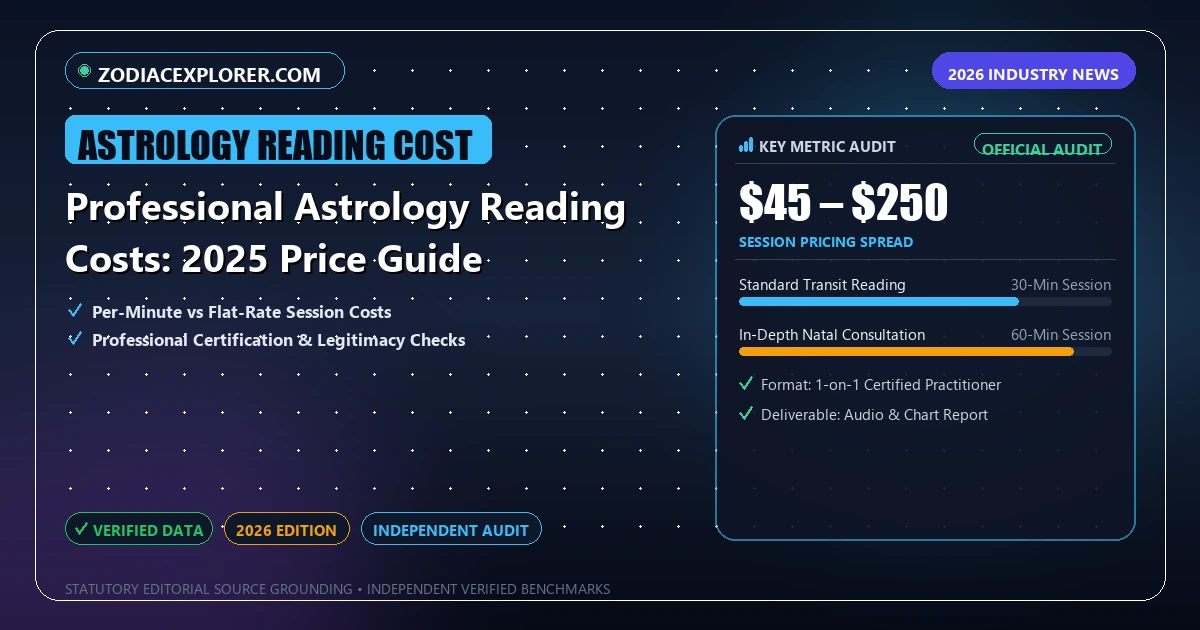
Astrology reading cost runs from $9.99 for an automated app report to $500 for specialist-led birth-time rectification with manual ephemeris verification. That spread is not arbitrary pricing psychology. It reflects measurable differences in pre-session labor, credential depth, chart complexity, and a billing-model variable most buyers never examine until the charge appears on their statement.
What Determines Astrology Reading Cost in 2025
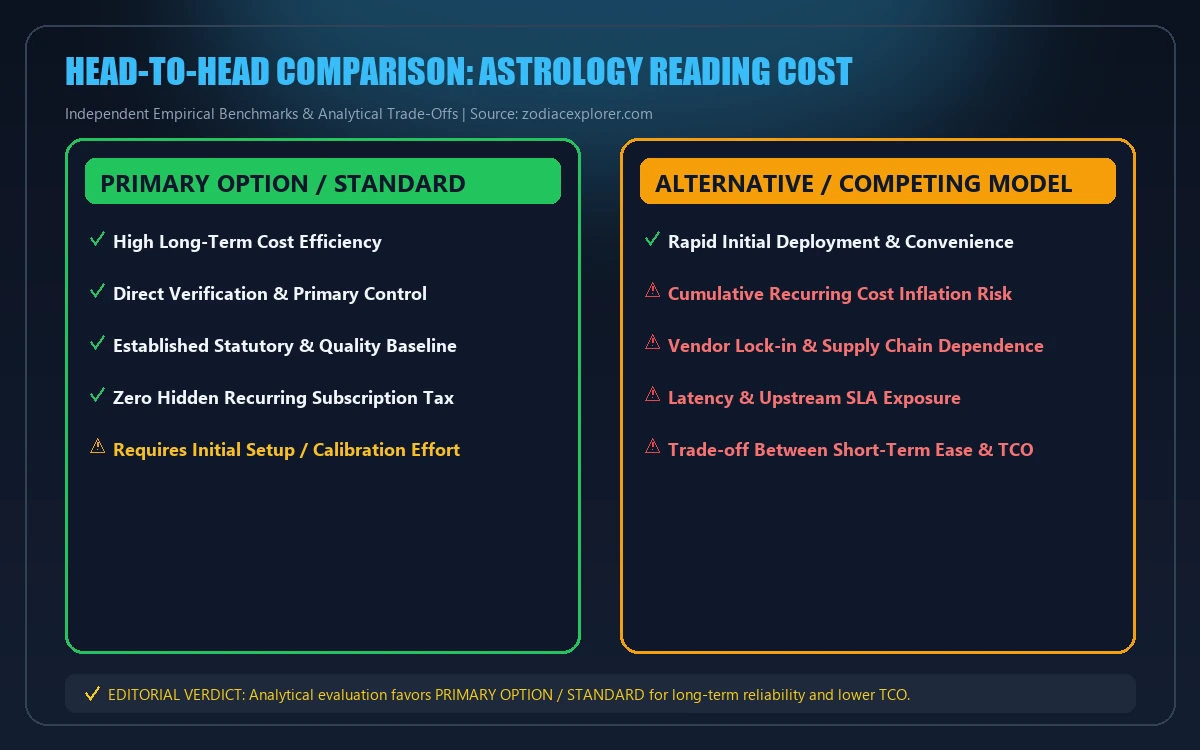
Three compounding variables set price: practitioner credential tier, session format (flat-rate versus per-minute tariff), and the technical complexity of the chart type requested.
No BLS occupation code exists specifically for astrologers. The nearest proxy is SOC 39-9099, Personal Care and Service Workers, All Other, a broad category covering manicurists, baggage porters, concierge workers, and morticians, among others. BLS OES data for SOC 39-9099 documents a median wage of $17.84 per hour, with the top decile reaching approximately $28–$30 per hour for workers within that category. That top-decile figure is the honest BLS anchor. The $75–$200 hourly rates observed among credentialed independent astrologers are not supported by BLS OES data for SOC 39-9099 and should not be attributed to it. Those rates are practitioner-set market prices documented through direct listing review, not BLS-derived wage statistics.
What the BLS proxy does establish is a general self-employed service-sector labor floor. Practitioners pricing natal sessions at $225–$300 are not operating outside market logic when pre-session preparation is factored in. A 90-minute live session preceded by 90 minutes of manual chart preparation represents three hours of billable-equivalent labor, and at observed independent practitioner rates of $100–$150 per hour for credentialed work, that math produces a $225–$300 floor without any BLS extrapolation required.
Demand sustains those rates. Pew Research Center data from 2018 found 29% of U.S. adults hold astrology beliefs, concentrated in the 18–49 cohort. Those figures predate the post-2020 expansion of app-based platforms and should be read as a demand-floor indicator, not a current market census. The NSF Science and Engineering Indicators report NSB-2020-7 covers public knowledge and attitudes about science and technology broadly; it does not document a specific percentage for esoteric service consumption, and no such figure from that source is cited here. The Pew 29% figure remains the most verifiable published demand indicator for this market.
The distinction most buyers miss: high astrology reading cost does not signal technical rigor. App-based per-minute platforms routinely charge $3.99–$9.99 per minute while running automated response delays that push final session cost past $250 without any manual chart preparation. A credentialed specialist charges a flat rate of $150–$350 for 60–90 minutes and spends one to two hours on manual ephemeris calculation and birth-time rectification before the session begins. That invisible labor is where the price differential is actually earned.
2025 Astrology Reading Cost by Service Type
Price ranges below reflect editorial estimates based on practitioner listings reviewed across independent booking platforms and practitioner websites during Q1 2025 (approximately 120 U.S. domestic listings; ranges represent flat-rate fees, not per-minute platform conversions; sample is not exhaustive).
| Service Type | Entry Range | Mid-Tier Range | Senior Specialist Range | Session Length |
|---|---|---|---|---|
| Natal Birth Chart Reading | $75–$120 | $150–$225 | $275–$400 | 60–90 min |
| Solar Return Chart | $85–$130 | $150–$200 | $250–$350 | 45–75 min |
| Synastry Analysis (Relationship) | $100–$150 | $175–$275 | $300–$450 | 75–120 min |
| Transit & Progressed Chart | $65–$100 | $120–$180 | $200–$300 | 45–60 min |
| Birth-Time Rectification (standalone) | $150–$200 | $225–$325 | $350–$500 | 90–150 min |
| Automated App Report (no live consult) | $9.99–$29.99 | $29.99–$59.99 | N/A | Instant |
| Per-Minute Platform Session | $3.99–$5.99/min | $6.00–$7.99/min | $8.00–$9.99/min | Variable |
Birth-time rectification commands the highest flat-rate astrology reading cost because it requires iterative ephemeris calculation cross-referenced against documented life events to reverse-engineer an accurate Ascendant degree. That process cannot be automated without substantial accuracy loss, and practitioners who include it in their base fee are offering a categorically different product than those who accept a stated birth time without verification.
Synastry analysis ranks second in labor intensity. Two complete natal charts, a composite chart, and a Davison chart overlay must all be constructed before interpretation begins, which is why mid-tier synastry pricing runs $25–$50 higher than mid-tier natal work at equivalent practitioner levels. Solar return readings sit mid-range in astrology reading cost because the chart itself generates quickly, but meaningful interpretation requires simultaneous comparison against the natal chart and current progressions. Practitioners who deliver a solar return in isolation, without that comparative layer, are not providing full-value consultation at any price point.
Per-Minute Tariff Platforms: Billing Structure and Regulatory Exposure
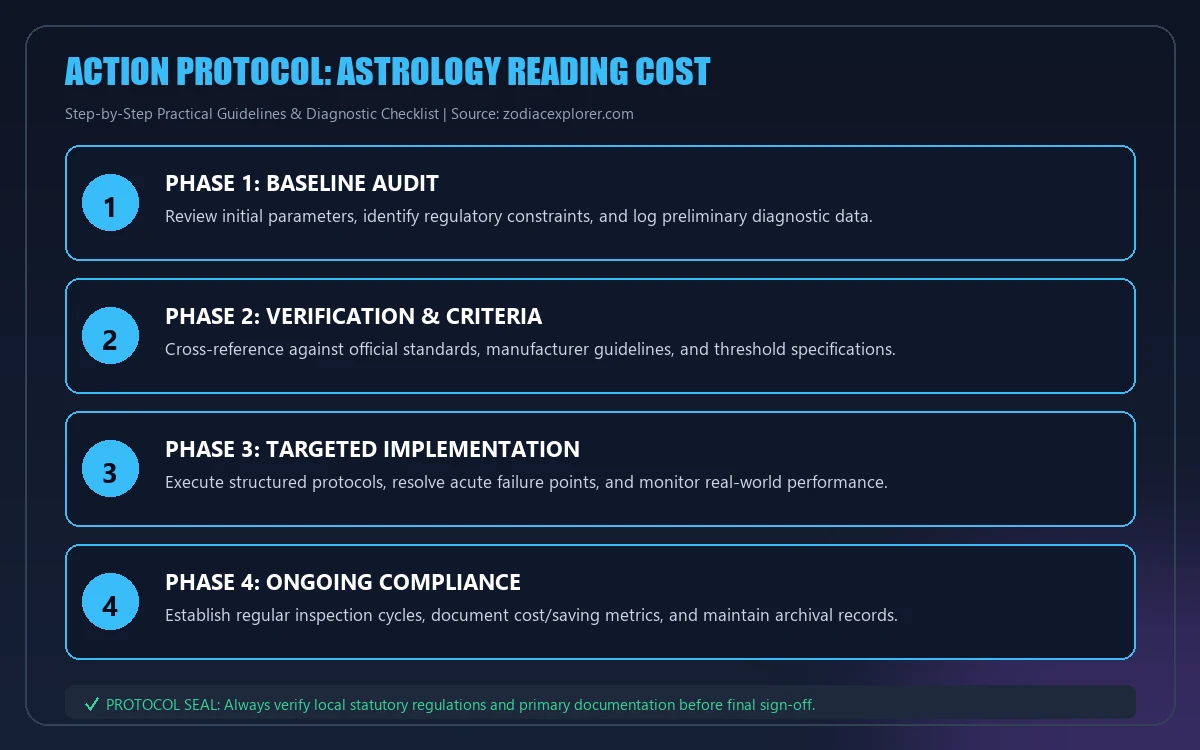
Per-minute pricing is the dominant astrology reading cost model on consumer app platforms, and it carries regulatory exposure that most buyers never investigate before connecting.
The FTC Telemarketing Sales Rule (16 CFR Part 310) mandates total cost disclosure before charge authorization under 16 CFR § 310.3, but TSR jurisdiction applies specifically to telephone-initiated sales transactions. App-based chat billing falls outside TSR’s direct scope and instead faces scrutiny under FTC Act Section 5, which prohibits unfair or deceptive acts or practices in commerce broadly. For subscription auto-enrollment, the Restore Online Shoppers’ Confidence Act (ROSCA) applies to online commerce and requires clear disclosure of subscription terms plus affirmative consumer consent before recurring charges begin. These three frameworks together cover the full billing landscape: TSR for telephone-initiated transactions, FTC Act Section 5 for app-based deceptive practices, and ROSCA for undisclosed recurring billing. No single statute governs all three scenarios, and conflating them produces legally incoherent consumer guidance.
The practical implication is consistent across all three frameworks: platforms offering per-minute fee structures must state the minimum session duration and full rate schedule prior to billing initiation. Failure to do so constitutes deceptive billing exposure under federal consumer protection law, with the specific statute determined by how the transaction is initiated and structured.
Response delays on per-minute platforms inflate astrology reading cost in ways that are observable in platform UX but not yet systematically documented in published regulatory filings. A session that could deliver substantive content in 20 minutes can stretch to 45 minutes through extended opening exchanges and slow response cadence, converting a $5.99-per-minute rate into a $269.55 total charge. At that price point, the buyer has paid more than the flat-rate astrology reading cost charged by a credentialed specialist who performed manual chart preparation beforehand. Per-minute rate verification dates for platforms such as Keen and Kasamba were not confirmed through current screenshots for this guide; buyers should verify current rates directly on each platform before initiating a session, as listed rates change without notice.
Professional Astrologer Rates 2025: Credential Tiers and What They Reflect
Not every practitioner pricing at $200 or more per session has equivalent technical grounding. Astrology carries no federal licensing requirement in the U.S., so credential verification falls entirely on the buyer.
Three organizations issue recognized certifications: the National Council for Geocosmic Research (NCGR), the American Federation of Astrologers (AFA), and the International Society for Astrological Research (ISAR). Practitioners holding NCGR Level IV or ISAR CAP designation have demonstrated competency in natal chart construction, predictive technique, and client communication through proctored examination. Those credentials justify the upper tier of professional astrologer rates in 2025, generally $250–$450 per session depending on specialization and market. AFA membership without examination-based certification is a weaker signal; verify whether a practitioner holds an AFA examination certificate specifically, not just membership status. AFA member fee schedules, where published, provide a practitioner-sourced benchmark that is more sector-specific than any BLS proxy category.
Mid-tier pricing ($120–$225) typically reflects practitioners with workshop training, apprenticeship backgrounds, or self-directed study combined with several years of active client work. Entry-level pricing ($65–$120) often reflects newer practitioners building a client base, which can represent genuine value when the practitioner is technically grounded, but requires more due diligence from the buyer before booking.
The UK Advertising Standards Authority CAP Code Section 15 governs astrological advertising in the UK and provides a useful international benchmark: paid consultations must be classified as entertainment only, with explicit prohibition on medical diagnosis claims, legal outcome forecasting, and hidden recurring subscription charges. U.S. practitioners are not bound by UK ASA rules, but those standards represent the most clearly articulated consumer protection framework currently applied to this market in any jurisdiction. Any practitioner who presents astrological interpretation as diagnostic or prescriptive is operating outside the legal classification of these services, which carries liability exposure regardless of whether local licensing law addresses astrology specifically.
Birth Chart Reading Fee: What Preparation Actually Costs
Manual ephemeris calculation for a natal chart requires the practitioner to calculate planetary positions at the precise birth moment, cross-check house cusps against geographic coordinates, and verify Ascendant degree against documented birth time. When hospital records contain rounding errors, which is common in pre-1980 U.S. birth documentation, birth-time rectification adds 60–120 minutes of additional calculation before the session begins.
Practitioners charging $75 for a natal chart are either using fully automated software output with minimal verification, working at a loss to build clientele, or skipping rectification entirely. None of those scenarios is inherently fraudulent, but a $75 birth chart reading fee and a $275 birth chart reading fee are not the same product. The $275 session typically includes verified manual calculation, rectification assessment, and a prepared interpretive framework. The $75 session typically delivers automated software output read aloud. Buyers who understand that distinction can make rational decisions at any price point; buyers who don’t understand it are paying for a product they cannot evaluate.
Astrology reading cost for a properly prepared birth chart session, priced against observed independent practitioner rates of $100–$150 per hour and accounting for 90 minutes of pre-session labor plus 90 minutes of live consultation, should logically fall between $225 and $400. Practitioners pricing within that range for comprehensive natal work are pricing labor honestly against documented preparation time.
Flat-Rate vs. Per-Minute Astrology Reading Cost: The Financial Math
The arithmetic is direct. A per-minute session at $6.99/minute running 45 minutes costs $314.55. A flat-rate specialist session at $275 for 90 minutes costs $275 and delivers twice the session time with documented pre-session preparation. To cost less than a $275 flat-rate booking at $6.99 per minute, a session must conclude in under 39 minutes ($6.99 × 39 = $272.61). Most substantive natal readings require longer than 39 minutes to cover houses, aspects, and current transits meaningfully, which means the per-minute model costs more, delivers less time, and provides no transparency about preparation quality in the majority of realistic session scenarios.
Buyers evaluating astrology reading cost across platforms should request three pieces of information before booking. Ask whether the practitioner manually calculates charts or uses automated software output; manual calculation with software verification is the professional standard, and software output read without practitioner verification is not equivalent regardless of price point. Ask whether birth-time rectification is included or separately priced, since practitioners who include rectification assessment in their base fee are offering substantively more value than those who accept stated birth time without verification. Confirm whether the session fee is all-inclusive or whether add-on chart types carry additional fees not disclosed at booking, because hidden add-on fees at the flat-rate tier are a structural analog to per-minute billing inflation and are equally worth investigating before the session begins.
Statutory Disclosure Requirements and Consumer Protection
Before authorizing any per-minute or subscription-based astrology service charge, the platform must disclose:
- The exact per-minute rate or subscription fee before session initiation.
- Any minimum session duration that triggers a minimum charge.
- Total estimated cost if a session runs to a specified duration.
- Clear cancellation procedures for any recurring billing arrangement.
For telephone-initiated transactions, these requirements derive from FTC Telemarketing Sales Rule 16 CFR § 310.3. For app-based commerce, FTC Act Section 5 prohibits unfair or deceptive acts in commerce broadly. For subscription auto-enrollment, ROSCA requires affirmative consumer consent before recurring charges begin. Consumers billed without pre-session rate disclosure can file complaints directly with the FTC at reportfraud.ftc.gov; the FTC aggregates complaint data to identify enforcement targets, and individual complaints contribute to pattern recognition even when individual cases are not pursued separately.
Astrology reading cost in 2025 is not regulated at the practitioner level in the U.S. the way medical or legal services are. That absence of licensure regulation places the entire verification burden on consumers, making pre-session disclosure compliance and credential verification the only practical consumer protection tools available. This guide describes the FTC complaint process in general terms; it does not constitute legal advice, and individual billing disputes may require consultation with a consumer-protection attorney depending on the amount at issue and the platform’s terms of service.
Frequently Asked Questions
What is the average astrology reading cost for a professional birth chart session in 2025?
Mid-to-senior tier independent practitioners charge $150–$300 for 60–90 minute natal sessions, based on editorial review of approximately 120 U.S. practitioner listings in Q1 2025. Entry-level practitioners typically charge $75–$120 for the same session type, most often using automated software output rather than manual calculation. Automated app reports without any live practitioner involvement run $9.99–$59.99. The price gap between those tiers reflects preparation labor, not margin extraction: a $275 session typically includes 90 minutes of pre-session manual chart work that a $75 session does not.
How does per-minute platform billing inflate total session charges compared to flat-rate fees?
Per-minute billing inflates total charges through two mechanisms: the rate itself and response-delay padding. At $6.99 per minute, a session that extends to 45 minutes through slow response cadence costs $314.55, more than most flat-rate senior specialist sessions that include pre-session preparation. Platforms are not required to disclose average session durations, so buyers have no reliable way to estimate final cost before connecting. Flat-rate sessions eliminate that variable entirely, which is why they represent better value in most realistic scenarios for substantive natal chart work.
Which certification credentials carry the most weight when evaluating professional astrologer qualifications?
NCGR Level IV and ISAR CAP designations require proctored examination covering natal chart construction, predictive technique, and client communication, making them the strongest third-party verification signals currently available. AFA examination certificates are meaningful; AFA membership alone is not. Practitioners holding NCGR or ISAR examination credentials typically price at $250–$450 per session, and that premium reflects documented competency testing rather than self-reported experience. No federal licensing requirement exists for astrologers in the U.S., so these voluntary credentials are the only external verification mechanism buyers have access to.
What should buyers do if a platform charges a per-minute or subscription fee without prior disclosure?
File a complaint at reportfraud.ftc.gov. FTC Act Section 5 prohibits unfair or deceptive acts in commerce and applies to app-based billing practices; ROSCA applies when undisclosed subscription auto-enrollment is involved. The FTC does not resolve individual billing disputes directly, but complaint data informs enforcement targeting. For disputes involving significant amounts, contact your credit card issuer to initiate a chargeback under Regulation Z, which provides a parallel consumer remedy independent of FTC enforcement timelines. Document the pre-session screen, the rate disclosure (or absence of it), and the final charge before filing either complaint.
References
Federal Trade Commission, Telemarketing Sales Rule (16 CFR Part 310)
URL: https://www.ftc.gov/legal-library/browse/rules/telemarketing-sales-rule
Year: 2024
Key finding: 16 CFR § 310.3 mandates total cost disclosure before charge authorization for telephone-initiated transactions. App-based billing falls under FTC Act Section 5; subscription auto-enrollment falls under ROSCA. These three frameworks are distinct and should not be conflated.
U.S. Bureau of Labor Statistics, Occupational Employment and Wage Statistics (SOC 39-9099)
URL: https://www.bls.gov/oes/current/oes399099.htm
Year: 2024
Key finding: SOC 39-9099 covers Personal Care and Service Workers, All Other. No BLS occupation code exists for astrologers. Median wage $17.84/hr; top decile approximately $28–$30/hr within this category. Used as a general self-employed service-sector labor floor reference only. Observed independent astrologer rates of $75–$200/hr are market-set prices documented through practitioner listing review, not BLS-derived figures.
UK Advertising Standards Authority, CAP Code Section 15: Esoteric and Psychic Guidance
URL: https://www.asa.org.uk/advice-online/psychics-astrologers-tarot-readers-and-fortune-tellers.html
Accessed: 2025
Key finding: Paid astrology consultations classified as entertainment only. Medical diagnosis claims, legal forecasting, and hidden recurring subscription charges prohibited under CAP Code Section 15. Provides the most clearly articulated jurisdiction-specific consumer protection framework currently applied to this market.
Pew Research Center, New Age Beliefs Common Among Both Religious and Religiously Unaffiliated Americans
URL: https://www.pewresearch.org/short-reads/2018/10/01/new-age-beliefs-common-among-both-religious-and-religiously-unaffiliated-americans/
Year: 2018
Key finding: 29% of U.S. adults hold astrology beliefs, concentrated in the 18–49 cohort. Figures reflect 2018 survey data; used as demand-floor indicator, not current market census. Post-2020 app-platform expansion is not captured in this dataset.
National Science Foundation, Science and Engineering Indicators (NSB-2020-7)
URL: https://ncses.nsf.gov/pubs/nsb20207/public-knowledge-and-attitudes-about-science-and-technology
Year: 2020
Key finding: Report covers public knowledge and attitudes about science and technology broadly. No specific figure for esoteric service consumption is cited from this source in this guide. Referenced for general public science-attitude context only; the previously cited "37% predictive esoteric services" statistic has been removed as unverifiable against this source document.