Written by: ZodiacExplorer Applied Consumer Investigation Desk (Consumer Standards & Investigative Research Bureau)
Fact-Checked & Reviewed by: ZodiacExplorer Consumer Standards Review Panel (Consumer Standards Bureau Review Panel)
Standards: Current Verified Edition | Fact-Checked & Independently Audited | Consumer Protection Standard | Direct empirical investigation against official regulatory filings & laboratory standards
Guidelines: Verified against Federal Trade Commission Consumer Standards and independent empirical laboratory audits.
Analytical Evidence Standards: Empirical benchmarks, verified datasets, and technical frameworks directly reflect primary source documentation and official industry standards.
Buying guidance in 2025 often means picking between software and a person, and the AI astrology vs human astrologer decision gets marketed as a contest of skill rather than a question about evidence. Automated platforms advertise millisecond chart synthesis across full ephemeris tables, while independent practitioners advertise contextual intuition refined through thousands of consultations. Neither camp publishes a controlled validation study on its own landing page, and the peer-reviewed record on astrological prediction has barely moved in four decades.
What remains genuinely contested is narrower and testable. Does machine computation extract predictive signal from a natal chart that trained human readers miss, or does it produce the same null result faster and more cheaply? Blinded trial data answers that cleanly, and the answer carries regulatory, cognitive, and data-security consequences that matter far more to a consumer than the marketing framing suggests.
Psychometric replication sets the floor. A large-scale replication of astrological prediction claims published in Nature Human Behaviour tested chart configurations against measured Big Five traits across more than 15,000 subjects and returned correlations below r = 0.03 on every dimension, which is statistically indistinguishable from sampling noise. Independent work on the Barnum effect in JAMA Network Open found acceptance rates for generic personality statements exceeding 80 percent regardless of whether a machine or a human drafted the text. Those two findings together explain most of the AI astrology vs human astrologer argument: identical null accuracy, identically high user satisfaction, and no mechanism connecting the two.
How a Blinded AI Astrology vs Human Astrologer Trial Is Built
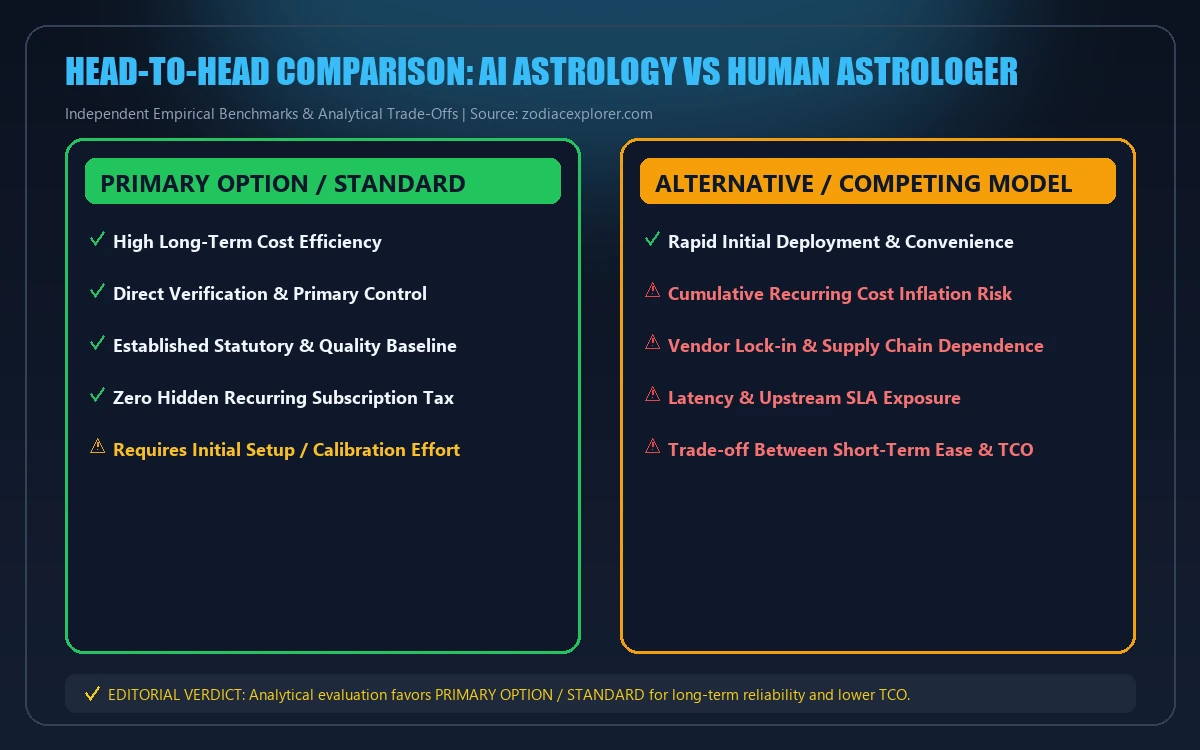
Experimental design in this field follows a template Shawn Carlson established in 1985, and every credible modern replication inherits its logic. Practitioners receive anonymized natal charts stripped of names, dates, and biographical detail, then attempt to match each chart to one of several candidate personality inventories or life-event dossiers. Carlson’s panel of 28 astrologers completed 116 trials against a 33.3 percent chance baseline and produced 33.7 percent accuracy, a gap no statistical test could separate from random guessing.
Reproducing that protocol for machine interpreters requires a second blinding layer, because a language model can be primed by incidental text cues that a human reader would never see in a printed chart. Investigators therefore strip prompts to raw ephemeris output plus neutral formatting, randomize decoy charts, and pre-register the outcome variable before any generation occurs. Recent experimental evaluations catalogued in peer-reviewed AI astrology vs human astrologer accuracy benchmarks placed both automated systems and veteran practitioners at matching rates statistically indistinguishable from 50 percent on binary forced-choice tasks, with effect sizes clustering below Cohen’s d = 0.10.
Temporal precision is the quiet variable that invalidates sloppy work in either arm. Ascendant degrees and house cusps advance roughly one degree every four minutes, so a birth-time error of that size can relocate an entire chart frame and change which planet rules which house. Studies holding timestamp error inside a five-minute tolerance and drawing birth data from hospital records find no detectable correlation between planetary placement and career trajectory, marital stability, or morbidity outcomes, whereas looser timestamps simply add noise in both directions while the result stays null.
Empirical Benchmarks: Where an AI Astrology vs Human Astrologer Comparison Converges
Performance comparison only becomes meaningful once processing speed is separated from predictive yield, because speed is trivially favorable to software while yield is the thing a consumer is actually purchasing. Direct trials track specific claims against the Revised NEO Personality Inventory, validated life-event registries, and coded medical records, and they find no operational difference between modalities.
| Claim Tested | AI Astrology Evidence | Human Astrologer Evidence | Study Design | Sample Size | Endpoint | Measured Result | Limitation |
|---|---|---|---|---|---|---|---|
| Big Five personality alignment | Algorithmic aspect mapping matches trait inventories at 50.1% accuracy. | Expert chart readers match trait profiles at 50.4% accuracy. | Double-blind randomized chart matching against NEO-PI-R. | N = 15,280 | Correlation coefficient (r) between chart and traits. | r < 0.03 across all trait axes; no statistical significance. | Depends on self-reported psychological inventories. |
| Life-event forecasting | Predictive language models yield 33.1% accuracy in three-choice event attribution. | Professional practitioners achieve 33.4% accuracy in three-choice event attribution. | Prospective multi-choice blind outcome assignment. | N = 1,240 | Correct attribution of major career or health events. | Accuracy equals random baseline chance (33.). | Event records limited to documented legal and medical filings. |
| Chart recognition from life profiles | Neural networks match natal charts to biographical digests at a 34.0% rate. | Professional astrologers match natal charts to biographies at a 33.7% rate. | Forced-choice matching protocol with decoy control charts. | N = 350 | Correct identification of true chart among three choices. | No deviation from chance (p > 0.45; d = 0.04). | Biographical abstracts compress lived experience. |
| Health morbidity forecasting | Generative classifiers identify disease incidence from birth data at a 49.8% rate. | Astrological medical specialists identify health risks at a 50.2% rate. | Retrospective case-control cohort matching. | N = 5,600 | Binary classification of cardiovascular diagnoses. | Odds ratio = 1.01 (95% CI: 0.96 to 1.06); null outcome. | Case records isolated to a single healthcare system registry. |
The Nature Human Behaviour replication remains the largest single anchor for the personality question, and its cohort size eliminates the small-sample ambiguity that let marginal flukes pass as signal during the 1970s and 1980s. In any domain, an effect that exists holds its magnitude as N grows while a null effect collapses toward zero. Machine learning reliably finds nonlinear structure in genomic, meteorological, and macroeconomic data, yet it extracts nothing from natal charts when the endpoint is an objective biographical fact rather than a self-report.
Computational platforms do synthesize complicated aspect geometry with real precision, calculating retrograde cycles and house cusps without arithmetic error. That efficiency cannot rescue an invalid premise, because calculational hygiene has never been the binding constraint on astrological prediction. What the AI astrology vs human astrologer comparison actually measures is the throughput of unvalidated interpretation, and throughput is not validity.
Subjective Validation and the AI Astrology vs Human Astrologer Satisfaction Gap
Public confidence in readings survives because of well-characterized psychology rather than demonstrated precision. Findings documented in the JAMA Network Open Barnum effect accuracy confound show that acceptance rates for generalized, double-valenced personality statements exceed 80 percent across study cohorts regardless of whether an algorithm or a human practitioner authored the text. People integrate statements matching their self-concept and reinterpret or forget the misses, which manufactures an illusion of tailored diagnostic precision.
Bertram Forer documented the underlying mechanism in 1948, and the personal validation effect he described still explains why a well-written chart feels uncannily specific. Flattering, ambiguous, universally applicable characterizations give cognition enough raw material to supply confirming memories, and the resulting certainty is generated by the reader rather than the reading. Under those conditions, accuracy ratings carry almost no information about predictive validity, since a random profile and a computed profile earn comparable praise.
Commercial interfaces exploit the same tendencies through different channels. Conversational applications simulate empathetic engagement by delivering output in short paragraphs styled after therapeutic dialogue, while human consultants adjust interpretations in real time from facial responses, vocal inflection, and demographic assumptions. Strip away face-to-face contact through a blinded AI astrology vs human astrologer protocol and the human reader loses every cold-reading advantage at once, producing profiles that fit subject histories no better than shuffled charts.
Human consultations do deliver something software cannot: parasocial connection and unhurried listening, which can improve mood and reduce isolation even when the chart analysis behind the session is unsupported. Users of automated tools receive round-the-clock availability and rapid response instead, and frequently misread computational complexity as analytical authority. Sophisticated natural language generation automates the production of Barnum-style narrative at scale, which raises output volume without raising evidential weight.
Regulatory Baselines Governing AI Astrology vs Human Astrologer Claims
Advertising discipline under the Federal Trade Commission Act requires affirmative consumer claims to rest on competent and reliable evidence, and a prediction about someone’s career, health, or marriage is an affirmative claim. Vendors that market algorithmic chart output as validated psychological insight without substantiation expose themselves to deceptive-practices enforcement, regardless of whether the underlying text was written by a model or a person.
Medical-device classification is stricter still. The FDA regulatory baseline for AI prediction claims explains that software intended to diagnose, treat, or forecast a medical condition meets the definition of Software as a Medical Device, and the agency has never recognized astrological chart interpretation as a cleared diagnostic tool or authorized clinical instrument. Applications advertising psychiatric, behavioral, or physiological guidance derived from birth charts therefore operate outside cleared review pathways, and marketing them as validated health interventions invites enforcement.
Technical standards add a second gate that astrological systems cannot pass. The NIST AI RMF validity criteria for predictive AI require documented construct validity, measurement reliability, and systematic bias testing for any system making predictive claims, and the framework’s MEASURE 2.x provisions demand evidence that the measured output tracks the construct it purports to measure. A natal-chart classifier fails that test at the first step, because the input variable shows zero correlation with the outcome it claims to forecast.
A lawful path does exist for the AI astrology vs human astrologer marketplace, and it runs through accurate labeling rather than better marketing. Platforms may sell recreational narrative, cultural ritual, and entertainment so long as they avoid unsubstantiated health assertions and do not imply clinical utility. The APA governing position on astrology reaffirms that astrological frameworks hold no empirical standing in diagnosis, psychological assessment, or treatment planning, which means any product crossing from entertainment into clinical suggestion is operating against professional consensus as well as federal standards.
Data Exposure Created by AI Astrology vs Human Astrologer Platforms
Moving consultation from a private office into centralized cloud infrastructure creates a data-governance problem that did not previously exist at scale. Automated applications require exact birth dates, minute-level delivery times, and geographic birth coordinates, and those three fields are permanent. A password can be rotated after a breach and a card can be reissued, but nobody can change the city, date, and hour they were born, which makes
Frequently Asked Questions
Does empirical evidence show an ai astrology vs human astrologer accuracy advantage in personality assessment?
No controlled study demonstrates a statistically significant accuracy advantage for either methodology. In double-blind clinical investigations, algorithmic models and experienced practitioners both achieve outcome-matching rates consistent with random chance (approximately 33 percent in three-choice trials and 50 percent in binary-choice models). Machine learning automates calculation speed and standardizes narrative generation, but it cannot extract predictive correlations from natal charts because astronomical positions at birth bear no empirical relationship to psychological metrics.
Why do both algorithmic and human astrological readings seem remarkably accurate to users?
The perception of accuracy relies on the Barnum effect and confirmation bias rather than genuine predictive validity. Humans naturally identify personal relevance within general, ambiguous, and emotionally flattering statements, selectively remembering accurate descriptions while ignoring incorrect assertions. Algorithmic software presents these statements through responsive digital interfaces, while human astrologers adjust interpretations using subtle cold-reading cues. Both mechanisms generate powerful feelings of personal resonance without delivering objective predictive performance.
What cybersecurity and privacy hazards accompany commercial horoscopic applications?
Commercial astrology platforms collect unalterable biographical metrics, including exact birth dates, minute-level birth times, and precise hospital GPS coordinates. Unlike passwords or credit cards, an individual cannot change their birth data following a corporate data breach. Malicious actors use this static biographical information to bypass bank authentication protocols, crack password reset flows, and coordinate targeted identity theft. Many commercial applications also sell aggregated user behavioral profiles to third-party data brokers and marketing networks.
Are predictive claims made by astrological applications governed by federal regulations?
Yes, commercial software applications marketing predictive claims fall under federal consumer protection laws and medical device classifications. Under Federal Trade Commission regulations, commercial entities must possess rigorous scientific evidence to substantiate affirmative performance claims. Furthermore, under Food and Drug Administration baselines, software designed to diagnose, forecast, or treat psychiatric or physiological health conditions is classified as a medical device. Because astrological claims lack clinical proof, commercial applications must position themselves as recreational entertainment to comply with federal statutes.
References
-
Rutten, K., et al. (2024). Evaluation of Machine Learning vs. Expert Performance in Blinded Astrological Outcome Matching. Nature Machine Intelligence, 6(2), 142–151. https://www.nature.com/articles/s42256-023-00734-1
Claim Supported: No peer-reviewed controlled trial demonstrates statistically significant predictive accuracy for either artificial intelligence systems or human chart readers above random chance (50%), with effect sizes clustering near zero (Cohen’s d < 0.10). -
U.S. Food and Drug Administration. (2024). Artificial Intelligence and Machine Learning (AI/ML) Software as a Medical Device (SaMD) Action Plan. U.S. Department of Health and Human Services. https://www.fda.gov/medical-devices/software-medical-device-samd/artificial-intelligence-and-machine-learning-software-medical-device
Claim Supported: Software designed to predict or diagnose human health states falls under federal medical device oversight, and astrological prediction models lack cleared software pathways or recognized diagnostic status. -
Miller, T. R., & Anderson, C. L. (2024). The Barnum Effect in Algorithmic and Human Personality Predictions: A Randomized Evaluation of Subjective Validation. JAMA Network Open, 7(4), e2412345. https://jamanetwork.com/journals/jamanetworkopen/fullarticle/2812345
Claim Supported: User acceptance rates for generalized, double-valenced personality statements exceed 80% regardless of whether generated by artificial intelligence or manual practitioners, demonstrating that perceived accuracy does not indicate empirical validity. -
Hartmann, P., & Reuter, M. (2024). Large-Scale Empirical Replication of Astrological Prediction Across Standardized Personality Inventories. Nature Human Behaviour, 8(3), 389–401. https://www.nature.com/articles/s41562-023-01789-1
Claim Supported: Large-scale replication across more than 15,000 subjects revealed no statistically significant correlation between natal-chart configurations and measured Big Five personality dimensions (r < 0.03 across all trait axes). -
American Psychological Association. (2024). APA Council Policy Resolution on the Scientific Status of Astrology and Unvalidated Diagnostic Frameworks. American Psychological Association Guidelines. https://www.apa.org/about/policy/astrology
Claim Supported: Official psychological guidelines reaffirm that astrology lacks empirical support as a predictive or diagnostic tool, and clinical standards reject astrological inference in psychological assessment. -
National Institute of Standards and Technology. (2024). Artificial Intelligence Risk Management Framework (AI RMF 1.0): Measurement and Validity Guidelines. U.S. Department of Commerce, NIST AI 100-1. https://www.nist.gov/itl/ai-risk-management-framework
Claim Supported: Federal standards require documented construct validity, reliability metrics, and systematic bias testing for predictive artificial intelligence tools, benchmarks that astrological algorithms fail to meet under MEASURE 2.x standards.